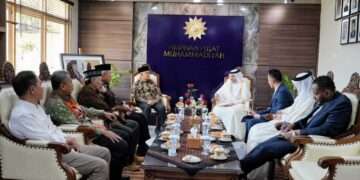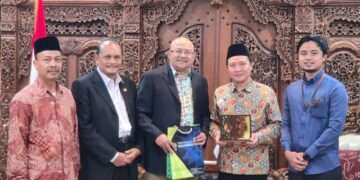


MUHAMMADIYAH.OR.ID, YOGYAKARTA – Muhammadiyah and Al-Quds University on Tuesday (13/01) formally signed a memorandum of understanding, reinforcing a shared commitment to global peace, humanitarian engagement, and long-term academic cooperation centered on Palestine.

The agreement followed a strategic meeting held on January 13 at Muhammadiyah University of Yogyakarta, where leaders from both institutions discussed frameworks for sustained collaboration. Rather than focusing solely on emergency humanitarian response, the partnership aims to build durable cooperation rooted in education, research, and peacebuilding.
In an interview on Wednesday (14/01), Yayah Khisbiyah, secretary of Muhammadiyah Department of International Relations and Cooperation (LHKI), said the meeting marked an important step in affirming Muhammadiyah’s solidarity with Palestine. According to her, the MoU provides an institutional foundation for collaboration that is equal, dignified, and sustainable.
“The discussion was then formalized in an MoU between Muhammadiyah and Al-Quds University,” Yayah said. “This agreement allows us to develop academic and humanitarian cooperation grounded in the spirit of South-South Cooperation.”
She explained that the partnership was designed in realistic and phased terms. Therefore, it includes both short-term and long-term programs, each aligned with institutional capacity and shared priorities.
Education, Research, and Values-Based Diplomacy
In the short term, the cooperation will focus on academic activities such as public lectures, international seminars, and thematic discussions on peace and global justice. In addition, both sides plan non-degree academic exchanges and initial collaborative research on public health, collective trauma, education in conflict zones, and peace studies. Humanitarian support, she added, will prioritize strengthening local capacity and educational institutions.
Over the longer term, the partnership aims to expand into joint research and international publications, the development of strategic academic programs and shared research centers, and scholarship and waqf-based educational endowments. These efforts seek to ensure sustained access to higher education while strengthening Global South academic networks.
“For Muhammadiyah, this cooperation reflects what we call ‘internationalization with values,’” Yayah said. “We must also consider the Islamic ethics, humanitarian responsibility, and social justice.”
Through its international institute, Muhammadiyah continues to advance humanitarian diplomacy, conflict studies, and community based reconciliation. At the same time, it is expanding collaboration across its universities and with international civil society partners.
Ultimately, the agreement signals that support for Palestine extends beyond empathy. Instead, it rests on knowledge, sustainability, and strategic solidarity, positioning education and research as tools for long-term peace and dignity. (Bhisma)
Translator: Bintang Adrian