

MUHAMMADIYAH.OR.ID, YOGYAKARTA – Muhammadiyah Council for Religious Opinion and Reform has reaffirmed its commitment to implementing a Unified Global Hijri Calendar (KHGT), arguing that a single worldwide Islamic date system is both religiously grounded and scientifically necessary.

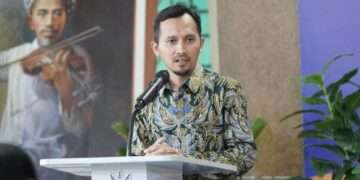
The pledge was delivered during a consolidation forum at Ahmad Dahlan University on Saturday (24/01). Speaking at the event, Arwin Juli Rakhmadi Butar-Butar outlined the theological, scientific, and historical foundations of the (KHGT)
At its core, KHGT rests on a simple principle: one day, one date for the entire world. Arwin stressed that the calendar is not limited to determining the start of Ramadan or Eid. Instead, it is intended as an integrated system for worship and civil administration alike.
“In practical terms, if today is agreed to be the fifth of Sha’ban, then it applies globally,” he said. “We must get used to using this calendar in daily life, organizational meetings, and official administration.”
From Moon Sighting to Global Timekeeping
Arwin described Muhammadiyah’s push for a global calendar as an effort to repay what he called a “civilizational debt.” For more than 14 centuries, he noted, Muslims have lacked a universally accepted time system. As a result, the start of lunar months can differ by two to five days. It is indeed far beyond what science or Islamic law can reasonably justify.
Astronomically, he explained, a lunar month lasts either 29 or 30 days. A one-day difference may still be defensible. However, larger gaps raise serious doctrinal and scientific concerns.
He also drew a comparison with the Gregorian calendar. Christians worldwide celebrate Christmas or Easter on the same date, regardless of geography. “If the Gregorian calendar can function globally,” he asked, “why not the Islamic calendar, when Islam places great emphasis on knowledge and order?”
A key shift under KHGT is the move away from wujudul hilal toward the imkan rukyat 5-8 criteria (a lunar altitude of five degrees and an elongation of eight degrees). Juridically, the system relies on the concept of a global horizon (ittihad al-mathali), supported by the majority of classical Islamic legal schools.
While KHGT is based on astronomical calculation (hisab) to ensure legal certainty, Arwin said moon sighting remains welcome as a devotional practice. However, its results cannot alter the official calendar.
“Consistency is essential,” he said. “Without it, a global time system would descend into chaos.”
Muhammadiyah leaders hope the calendar will serve as a lasting contribution to global order, aligning religious practice with scientific coherence in an increasingly interconnected world.
Translator: Bintang Adrian