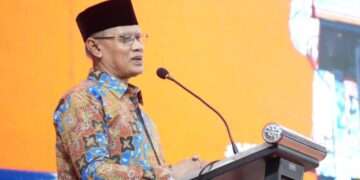
EN.MUHAMMADIYAH.OR.ID, YOGYAKARTA – Positions within Muhammadiyah’s Social Enterprises (AUM), including Muhammadiyah and ‘Aisyiyah Universities (PTMA), should follow the example of Khalid ibn al-Walid, one of Islam’s most prominent military commanders.

Irwan Akib, chairperson of the Muhammadiyah Central Board, delivered this message on Thursday (26/11) during the 32nd edition of the Kajian Kamisan, titled Risalah Islam Berkemajuan in PTMA governance. The Muhammadiyah Central Board’s Council for Higher Education, Research, and Development (CHERD) organized the online session.
Loyalty to the System
Irwan highlighted how Khalid ibn al-Walid remained loyal to the system even at the height of his military career. Despite his position as a leading Muslim commander, Caliph Umar ibn al-Khattab suddenly removed him from command.
“Khalid ibn al-Walid did not protest at all. He accepted the decision wholeheartedly and then sought clarification by asking Umar why he had been dismissed,” Irwan explained.
Irwan offered another perspective on the dismissal. He said removing a prominent figure at the peak of their career can prevent a personality cult from developing within an institution or organization.
Putting the System Above Individuals
In the context of leadership positions within Muhammadiyah, Irwan said officeholders must preserve a spirit of sincerity when entrusted with leadership responsibilities across the organization’s institutions and levels.
“Leadership is a trust. More importantly, every institution has a system that governs it, and that system must hold a higher position than any individual,” he added.
According to Irwan, Muhammadiyah must place its organizational system above individual figures. This principle, he said, is essential to maintaining sound governance across PTMAs.