

EN.MUHAMMADIYAH.OR.ID, JAKARTA — Muhammadiyah Internationalization needs to be strengthened by building global networks, expanding studies on the organization, and playing a greater role in Islamic diplomacy. Such efforts are considered important to enable Muhammadiyah’s experiences and ideas to contribute more broadly to global affairs.

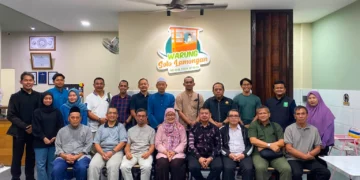
Ahmad Fuad Fanani shared the view during a Muhammadiyah Central Board study session in Jakarta on Friday (28/8). In his presentation, Fuad discussed four key issues: the importance of patriotism within Muhammadiyah, the reasons for internationalization, efforts that have been and still need to be undertaken, and the challenges ahead.
The Importance of Patriotism
Fuad stressed that Muhammadiyah Internationalization should not be seen as conflicting with love for Indonesia. Its history, he said, shows that many of its prominent figures maintained strong international connections while remaining deeply committed to their homeland.
He cited KH Kahar Muzakir and KH Mas Mansur, who studied abroad but retained a strong love for Indonesia. The same could be seen in the journey of KH Ahmad Dahlan, who traveled to Makkah twice. Rather than settling there, Fuad said, Ahmad Dahlan brought home the knowledge he had gained and developed it in Indonesia.
For this reason, Fuad believes that patriotism has deep historical roots within Muhammadiyah. In the struggle to build Indonesia, Muhammadiyah and other groups promoted the idea of Indonesia as a unified nation rather than one based on particular regional identities.
“What we embraced was the idea of Indonesia—not Javanese identity, Yogyakarta Identity, or any other regional identity,” he said.
According to Fuad, the Nusantara Muslim community’s relationship with the wider world also dates back centuries. He referred to Azyumardi Azra’s studies of Nusantara scholars who traveled to the Middle East in the 16th and 17th centuries and formed a community known as al-Bilad al-Jawi. Other scholars have also examined the contributions of Indonesian ulama and intellectuals to the development of nationalism.
From this history, Fuad concluded that patriotism and openness to the outside world are not contradictory. Muhammadiyah, he said, has a tradition of drawing ideas from different places, processing them, and applying them within the Indonesian context.
Why Muhammadiyah needs Internationalization
Fuad then explained why Muhammadiyah needs to strengthen its international presence. One foundation, he said, can be found in Surah al-Hujurat, verse 13, which states that humanity was created into different nations and tribes so that people may know one another, or li ta‘ārafū.
“The purpose is ta‘aruf. In today’s language, ta‘aruf means engaging in diplomacy, building networks, and connecting with others,” he said.
He also linked internationalization to Surah al-Jumu‘ah, verse 10, which contains the command fantashirū fī al-arḍ, or to spread throughout the earth after prayer. According to Fuad, the verse can inspire Muslims to build broader networks through dakwah, education, and service in different places.
“What we have today is not enough,” he stressed.
Fuad said Muhammadiyah’s strength has long been supported by its intellectual tradition and openness to the exchange of ideas. He identified at least two important aspects behind the organization’s sustainability: knowledge, or epistemology, and institutions.
From its earliest days, Muhammadiyah has not limited itself to ideas developed within its own circles. KH Ahmad Dahlan, for example, studied the works of Islamic reformers such as Muhammad Abduh and Rashid Rida, including Tafsir al-Manar. Those ideas were then studied, interpreted, and applied according to the needs of Indonesian society.
Its educational tradition has also been an important source of strength. Fuad said the relatively high educational background of Muhammadiyah cadres and leaders provides valuable capital for the organization’s development. Strengthening knowledge and literacy, therefore, should remain part of Muhammadiyah’s internationalization efforts.
As the global order changes, Fuad said the need for internationalization has become even greater. The world is no longer divided into a bipolar order, as it was during the rivalry between the United States and the Soviet Union, but is moving toward a multipolar landscape with increasingly diverse centers of power.
From Institutions to Ideas
These changes have also affected relations between the Muslim world and the West. Fuad said negative sentiments toward Islam continue to appear in parts of global discourse, particularly following the September 11 attacks and the rise of the war on terror narrative. In this context, he said, Muhammadiyah has an opportunity to introduce a moderate and open expression of Islam.
Indonesia and Muhammadiyah have important assets to play that role, Fuad added. Indonesia has a large Muslim population, democratic experience, human resources, and economic strength. Muhammadiyah, meanwhile, has extensive social and institutional capital.
He pointed to the organization’s hundreds of hospitals, universities, schools, Islamic boarding schools, and other charitable enterprises as strengths that distinguish it from many other transnational Islamic organizations.
“I think that is a major asset,” he said.`
However, Fuad described such institutions as the hardware of internationalization. To strengthen the effort, he said, Muhammadiyah also needs software in the form of ideas, studies, discussions, and knowledge production that can enter international conversations. He also cited the purchase of a church building in Spain by the East Java Muhammadiyah Regional Leadership as part of the organization’s growing international presence.
Fuad called for more serious and sustained studies of Muhammadiyah. He recalled his experience writing a dissertation on Muhammadiyah at the Australian National University. Initially, he had not planned to make Muhammadiyah the subject of his research. However, his supervisor, Greg Fealy, encouraged him to do so because international studies on Muhammadiyah’s development, particularly after the Reformasi era, remained limited.
Taking an Active Role in Global Diplomacy
During the research process, Fuad said he also received advice from Buya Ahmad Syafii Maarif. He was advised to write about Muhammadiyah critically and maintain the distance required of a researcher. A tradition of critical scholarship, he said, is necessary for Muhammadiyah to be understood more objectively by the international community.
In terms of diplomacy, Fuad suggested that Muhammadiyah adopt an active hedging approach. This means actively building cooperation with different countries and communities without limiting itself to any particular group or power.
“Active hedging means that we have to move and be willing to work with anyone,” he said.
Fuad also believes Muhammadiyah can serve as a bridge between Islam and the West. Cooperation with the government, Nahdlatul Ulama, and other organizations could help strengthen dialogue and reduce misunderstandings between Muslim and Western societies.
Muhammadiyah’s experience in several countries, he said, demonstrates the organization’s strong social capital. Its relatively open and welcoming image has helped it gain acceptance in international communities.
“This gives us greater capital for diplomacy,” he said.
A Strong Foundation for Global Engagement
Beyond serving as a bridge, Fuad encouraged Muhammadiyah to remain open to imams and Muslim leaders from different countries. Such openness, he said, could become part of a moderate Islamic diplomacy while preventing Muslim communities from becoming isolated along national or sectarian lines.
He also proposed that Muhammadiyah begin considering a greater role as a mediator in conflicts in the Middle East. According to Fuad, the ability to mediate does not depend solely on the power of states. It can also be developed through people-to-people relations.
“Mediation is something we can actually do and turn into concrete action,” he said.
Fuad said Muhammadiyah already has the infrastructure to develop such a role. Its branches, overseas special branches, schools, universities, and other charitable enterprises in various locations could serve as a foundation for building networks and people-to-people diplomacy.
However, he emphasized that institutional strength must be accompanied by the production of ideas. Studies, research, and discussions on Muhammadiyah need to expand so that the international community recognizes the organization through its ideas and contributions, rather than merely through its name or individual figures.
Ultimately, Fuad said, Muhammadiyah’s internationalization should focus on introducing its ideas, experiences, and contributions to the world. Muhammadiyah always values intellectual tradition, institutions, human resources, and existing networks. With that, Muhammadiyah has a strong foundation to expand its role in Islamic diplomacy and global affairs.