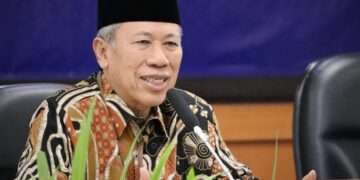


MUHAMMADIYAH.OR.ID, YOGYAKARTA – Pradana Boy, Chairperson of Division II of the Religious Preaching Council of Muhammadiyah’s Central Board, presented the concepts of tauhid developed by three prominent Muhammadiyah leaders during the 1447 H Ramadan Sermon held at the UMY Dormitory on Saturday (21/2).

In a session focusing on Muhammadiyah figures’ ideas of tauhid, he explored the exemplary monotheistic movements demonstrated by Ahmad Dahlan, Mas Mansur, and AR Fachruddin.
Before discussing their specific thoughts, Pradana Boy situated their ideas within the broader spectrum of tauhid theories developed by classical Muslim scholars, both early (salaf) and later (khalaf). He argued that although Islamic intellectual history offers diverse formulations of monotheism, the tauhid ideas of Muhammadiyah figures remain relevant and responsive to contemporary challenges.
“Among the many theories cited, the concepts and practical movements of tauhid advanced by Muhammadiyah figures align with the thoughts of those scholars,” he said.
KH Ahmad Dahlan: Tauhid and Concrete Action
According to Pradana Boy, Ahmad Dahlan possessed a sharp awareness of his era’s social transformations. His concept of tauhid, then, rested on pure monotheism, rejection of syncretism and superstition, and purification of Islamic teachings.
“He emphasized pure monotheism and rejected unfounded religious practices. Everything was grounded in that principle,” he explained.
In Dahlan’s character, Pradana Boy continued, thought and action were inseparable. He was both a man of thought and a man of action, ensuring that tauhid did not remain theoretical but became a catalyst for socio-religious reform.
KH Mas Mansur: Practical Tauhid and Progress
The second figure discussed was Mas Mansur, recognized as a reformer within Muhammadiyah’s intellectual tradition. He introduced the idea of Tauhid Amali—monotheism as the foundation of action and social ethics.
For Mas Mansur, tauhid formed the theological basis of compassion, love, and empathy without discrimination.
“Mas Mansur stated that Islam does not contradict reason. Islam must abandon stagnation and make tauhid the foundation of scientific and educational progress,” Pradana Boy noted.
KH AR Fachruddin: Simplicity and Authentic Faith
Meanwhile, AR Fachruddin, who served as Muhammadiyah’s Central Board Chairman from 1968 to 1990, exemplified tauhid through simplicity and moral integrity.
“When speaking about Pak AR, the key word is simplicity in practicing and understanding religion,” he said.
He, moreover, described AR’s personality as marked by simplicity, intelligence, and ethical humility. Quoting Ahmad Syafii Maarif, he added that AR was a figure who lived his religion authentically.
“Pak AR understood Islam as a teaching containing universal values,” he quoted.
Through this lecture, participants were invited to understand tauhid on three interconnected levels: intellectual truth, concrete practice, and sincerity of heart. Together, these dimensions form the moral and spiritual foundation of Muhammadiyah’s movement.
By emulating the ideas and praxis of these three leaders, tauhid emerges not as a rigid theoretical doctrine, but as a transformative energy driving Islamic renewal and the advancement of civilization. (Bhisma)