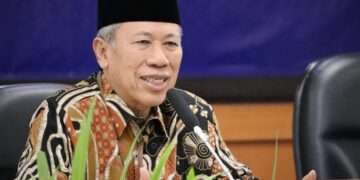


MUHAMMADIYAH.OR.ID, YOGYAKARTA — Ahmad Muttaqin, Secretary of the Higher Education, Research, and Development Council (Diktilitbang) of Muhammadiyah Central Board, presented the dynamic development of tawhid (Islamic monotheism) within Muhammadiyah’s intellectual tradition through an examination of key figures in the organization.

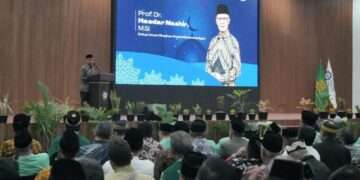
He delivered the presentation during the Central Board Ramadan Sermon at Universitas Muhammadiyah Yogyakarta on Saturday (21/2). He emphasized that tawhid in Muhammadiyah is not a static doctrine but one that evolves in response to historical contexts and the social needs of the Muslim community.
Muttaqin explained that he initially mapped the figures’ ideas using artificial intelligence (AI), then verified the findings with academic literature.
“The initial source was AI, and then I cross-checked it with several references I have. I compared them and selected what most closely reflects their ideas,” he said.
He also highlighted the importance of incorporating women’s perspectives into Muhammadiyah’s Islamic discourse, acknowledging the dominance of male voices in academic forums. This, he noted, should become an important reflection for the future development of tawhid studies.
Reformative and Emancipatory Foundations
Discussing Muhammadiyah’s founder, Ahmad Dahlan, Muttaqin described his concept of tawhid as reformative and purificatory, yet also rational and empathetic. Dahlan’s purification of faith was reflected in his rejection of superstition, religious innovations, and myth, while his empathetic dimension appeared in his defense of the marginalized through the theology of Surah Al-Ma’un.
“In conclusion, Kiai Dahlan’s concept of tawhid was reformative and purificatory, building a pure, rational, and empathetic foundation for the community,” he explained.
Turning to Siti Walidah, Muttaqin characterized her theology as egalitarian and emancipatory. She affirmed the spiritual equality of men and women, stressing that both share equal responsibility in faith and good deeds. Women, she argued, have the right to understand religion directly rather than merely follow tradition.
Social, Moral, and Organizational Dimensions
Mas Mansur, he continued, advanced a socially oriented and progressive tawhid. Affirming God’s oneness, in this view, means rejecting all forms of human oppression.
“Monotheism means refusing every form of human domination over others,” Muttaqin said, explaining the theological basis of Mansur’s social struggle.
In Hamka’s thought, he found a moral-intellectual expression of tawhid. Faith in one God shapes an independent soul, noble character, rationality, and openness to knowledge.
Meanwhile, AR Fachruddin represented an ethical-organizational dimension of tawhid, emphasizing moral integrity and loyalty within the organization. Commitment to the institution, he noted, is not limited to holding leadership positions.
Regarding Amien Rais, Muttaqin identified the concept of “social tawhid” as a driving force for structural reform. It functioned as a theology of liberation, rejecting tyranny and injustice, especially during Indonesia’s reform era.
Contextual and Transformative Compassion
The late Yunahar Ilyas, he explained, articulated a normative-contextual tawhid—maintaining doctrinal purity while addressing modern challenges such as materialism and secularism, which he described as forms of “modern shirk.”
As for Ahmad Syafii Maarif, tawhid became the foundation of humanitarian and national ethics. His perspective encouraged interfaith dialogue and criticized the politicization of religion, promoting inclusivity in the public sphere.
Finally, Muttaqin highlighted the concept of tawhid rahamutiyah developed by Hamim Ilyas as a transformative theology of compassion. Faith in God, he explained, entails embodying the attributes of ar-Rahman and ar-Rahim in social life, fostering justice, nonviolence, and respect for diversity.
A Living and Moving Theology
In conclusion, Muttaqin affirmed that Muhammadiyah’s evolving understanding of tawhid demonstrates continuity between theology and social praxis.
“The concepts of tawhid among Muhammadiyah figures are dynamic and develop according to their historical contexts, showing harmony between theology and practice,” he said.
For Muhammadiyah, he stressed, tawhid is not merely an abstract metaphysical doctrine. Rather, it is a functional idea—a spiritual foundation, a social ethic, and an energy for renewal.
“Tawhid in Muhammadiyah must be a tawhid that moves life,” he concluded.