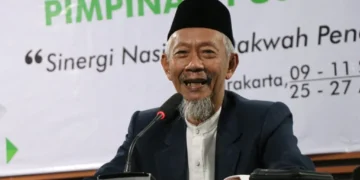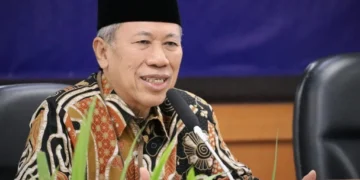


MUHAMMADIYAH.OR.ID, YOGYAKARTA – Talqis Nurdianto, member of the Council for Religious Preaching of the Main Board of Muhammadiyah, invites the congregation to understand and manifest the value of rabbani in daily life, mainly in facing the challenge of the digital era.

In a study session themed “Mewujudkan Generasi Rabbani” (Building a Rabbani Generation) at the K.H. Sudja Mosque on Sunday (21/09), Talqis began by explaining the concept of a rabbani generation. According to him, a rabbani generation refers to individuals or groups who have a strong connection with Allah SWT, possess knowledge, and put it into practice.
Referring to the Qur’an, Surah Ali Imran verse 79, he highlighted that a rabbani generation is made up of people who dedicate themselves to Allah, while also teaching and learning Qur’an with sincerity and awareness.
“Rabbani is more than just a name, it is a character marked by obedience, refraining from injustice, and never causing harm to others,” he said.
He also mentioned the contrast between the rabbani generation to a more popular term of “generasi micin” (MSG Generation) which he jokingly depicts as a generation that lives the digital lifestyle, but often lacking in spiritual value.
On the contrary, the rabbani generation is defined by four key characteristics: seeking and teaching knowledge of the Qur’an, worship as a way to grow closer to Allah, standing firmly for truth, and refusing to stay silent in the face of wrongdoing.
In today’s context, Talqis highlighted the urgency of digital literacy in shaping a rabbani generation. “Gadgets are not obstacles,” he said, “but tools that can strengthen us as long as we use them wisely.”
He stressed the importance of parental control to the children’s digital activity such as limiting the screen time and making sure the consumed content resonates with Islamic values.
Talqis also proposed the integration of a more structured digital curriculum, so children could gradually and systematically learn religious knowledge. He also emphasized that the parents’ role as uswah hasanah (good role model) is key.
Talqis asserted that parents must first implement the value of rabbani before teaching them to their children. “Behavioral examples are far more meaningful than mere words,” he said while telling his personal experience concerning the importance of modeling small habits like performing prayers and dressing modestly.
Character Building and Social Awareness
Talqis also highlighted the importance of character building and social awareness for kids. He urged the parents to train their kids to speak in public and socialize, as simple as taking children to the mosque or encouraging small interaction with neighbors.
“Don’t let our kids get trapped in their own little world. Give them a stage to speak good words,” he said while also reminding parents to accustom their children to read the Qur’an and perform five daily prayers.
By quoting the hadith, “The best among you are those who learn the Qur’an and teach it,” Talqis urged the congregations to not only be learners but also educators who spread knowledge.
He stressed that a rabbani generation is one that brings benefit to others, echoing the words of Prophet Muhammad (peace be upon him): “The post of people are those who are most beneficial to others.”
In his sermon, Talqis also referred to Surah Al-Falaq and An-Nas to illustrate the importance of seeking protection from both visible and hidden evils. He reminded the audience to recite the mu’awwidhat (Al-Ikhlas, Al-Falaq, and An-Nas) after prayer, calling it a simple yet meaningful practice.
He also quoted the opinion of Islamic scholars such as Ibn Abbas and Ali Ibn Abi Talib, who described a rabbani generation as one that is wise, gentle, and deeply knowledgeable of the Qur’an and hadith.
“A rabbani generation does not condemn differences of opinion,” he explained, “but approaches the core and branches of Islamic teachings with wisdom.”
As a closing remark, Talqis encouraged the use of technology as a tool for da’wah, especially in reaching younger generations like Gen Z.
“Digital da’wah must be adjusted to fit its audience. In England, for example, certain appearances may be needed to be accepted. While here we adapt to local culture,” he said. He stressed the importance of producing digital content that educates and inspires, while urging parents to guide their children so they are not exposed to harmful content.
The sermon concluded with a prayer, asking that both parents and children become part of a knowledgeable, devout, and beneficial rabbani generation. (Bintang Adrian)