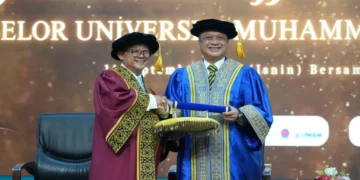


MUHAMMADIYAH.OR.ID, PERLIS – Universiti Muhammadiyah Malaysia (UMAM) has officially reached its fourth year. The President of Muhammadiyah, Haedar Nashir, stated that the internationalization of Muhammadiyah’s movement would not have been possible without the support of the Perlis Kingdom, the Mufti of Perlis, and the Malaysian government.

“With the establishment of UMAM in Perlis, Malaysia, a close relationship has also been forged between two kindred nations sharing the same Malaysian cultural heritage. UMAM thus becomes a cultural bridge for building an advanced civilization of these related nations, grounded in Islamic teachings in today’s modern world,” Haedar said on Thursday (27/11).
Haedar added that the establishment of UMKM is a core aspiration to expand Muhammadiyah’s higher education abroad. Through their mutual diversity, ukhuwah islamiyah and ukhuwah insaniyah between the two kindred nations can continue to strengthen strategic cooperation
“UMAM was founded with a long-term projection as one of the key milestones in developing a progressive Islamic civilization,” he explained. According to Haedar, Islam since its inception has played a very important and relevant role in the development of global civilization and international politics.
Amid the many challenges faced by the global Muslim community in recent decades, Indonesia and Malaysia, two kindred nations, share numerous similarities that position them to grow into an advanced regional community with a distinctive character.
These two nations share the fact that Islam is the primary strength embraced by the majority of their populations. Islam is not merely a religion of faith in God and a collection of ritual acts of worship; it is a religion that teaches values of civility and progress in various aspects of muamalah, serving as a grace to all creation,” said Haedar.
Haedar also asserted that Malaysia and Indonesia have the potential to become role models in developing an education system that nurtures a generation of ulul albab (intellect), distinct from the characteristics of western society.
“Furthermore, Islam and its communities in these two kindred Nations can become a Khayra Ummah (the best nation), one whose characteristics is being an Ummatan Wasatha (a moderate community), always present as witnesses to human civilization, syuhada ‘ala al-nas, bringing mercy to the universe,” he emphasized.
Therefore, educational institutions hold a crucial function: Islamic education as a holistic institution that integrates faith, ethics, and progress as core elements.
“Muhammadiyah hopes for UMAM to stand as an excellent and progressive institution of higher education,” Haedar concluded. (Bintang Adrian)