

MUHAMMADIYAH.OR.ID, YOGYAKARTA – The Central Board of Muhammadiyah Student Association (PP IPM) for the 2026–2028 term was formally inaugurated on Sunday (12/4), marking a pivotal moment for one of Indonesia’s largest student movements.

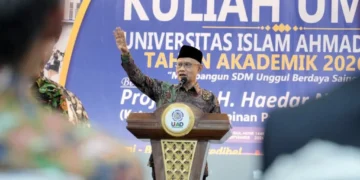
The ceremony took place at Amphitarium Hall, Campus 4 of Ahmad Dahlan University. During the event, Haedar Nashir, President of Muhammadiyah, stressed that the oath taken by the newly appointed leaders must carry real weight. Rather than serving as mere formality, he said, it should bind members to a moral commitment to fulfill the organization’s mission.
Muhammadiyah, he added, remains open to diverse pathways of cadre development as part of its inclusive vision. However, such openness requires strong dedication. IPM members form part of the organization’s core cadre, and therefore must uphold higher standards.
Adapting to a Complex and Centrifugal Era
At the same time, Haedar warned that the organization faces a rapidly shifting global landscape. He described today’s world as increasingly “centrifugal,” with forces that tend to fragment rather than unify. Therefore, he urged IPM to preserve organizational cohesion while adapting to change.
He also highlighted the unique traits of Generation Z, who have grown up immersed in digital culture. This environment offers new opportunities, yet it also creates challenges. In particular, balancing technological fluency with human values requires a deeper level of intelligence. “Integrating human dimensions with digital-native culture is not easy,” he said. “It demands thinking beyond ordinary limits.”
Moreover, Haedar emphasized the need to revive a strong intellectual tradition rooted in Islamic teachings. He pointed to the concept of Iqra, the command to read in the Qur’an, especially in Surah Al-‘Alaq, as well as the philosophical symbolism of “nuun wal qolami wa maa yasthuruun,” which reflects the pursuit of knowledge.
Faith, Knowledge, and Transformative Action
According to Haedar, IPM’s future direction must rest on faith as a divine and constant foundation. No matter how advanced individuals become, he said, spiritual awareness must remain present in every aspect of life. “In every breath of life, no matter how intelligent or advanced we are, God is always with us,” he said.
However, he argued that faith should not remain abstract. Instead, it must become progressive and transformative. The principle of tauhid should inspire knowledge, shape ethical behavior, and guide social responsibility. “Faith must enlighten life, expand knowledge, and open the universe,” he said, adding that it should lead to good deeds and the prevention of wrongdoing.
In his closing remarks, Haedar underscored the importance of understanding fundamental values derived from Islamic teachings and Muhammadiyah’s ideology. He urged students to engage these principles deeply, using approaches such as bayani, burhani, and irfani. Without such engagement, he warned, core values risk erosion over time.
Ultimately, the address made clear that IPM’s new direction cannot rely on routine administration alone. Instead, it must emerge as a dynamic, progressive, and transformative student movement—one that advances knowledge, sustains organizational vitality, and drives meaningful social change.
Therefore, IPM cadres are expected to surpass previous generations not only in intellectual capacity but also in moral integrity and tangible contributions to society. (Bhisma)