

MUHAMMADIYAH.OR.ID, JAKARTA – Muhammadiyah Central Board signed a memorandum of understanding with University of Indonesia on Monday (13/4), marking a strategic effort to strengthen collaboration between academia and civil society.

This agreement was formalized at the university’s convention hall in Depok by Haedar Nashir, President of the Muhammadiyah Central Board, and Heri Hermansyah, Rector of the University of Indonesia. The memorandum outlines cooperation in the field of education, with a focus on long-term institutional partnerships.
“We hope this agreement will not remain merely a document, but also followed by concrete actions,” Said Haedar during the signing ceremony.
The initiative follows a visit by University of Indonesia representatives to Muhammadiyah’s headquarters in Yogyakarta in February. According to Haedar, both institutions share a common mission: advancing national education and intellectual development.
Bridging Academia and Civil Society
Moreover, Haedar emphasized the importance of maximizing the roles of academic institutions and civil society organizations in guiding the nation’s future. As challenges grow more complex, he argued, collaboration between these sectors becomes increasingly essential.
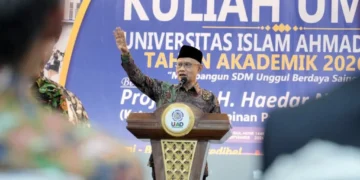
During the event, Haedar also delivered a public lecture addressing the role of intellectuals in academia and the broader responsibilities of civil society. He noted that academic communities contribute depth of knowledge and analytical rigor, while civil society organizations offer social awareness and transformative energy.
Heri Hermansyah echoed this view, describing the partnership as more than an institutional agreement. Instead, he framed it as a meeting of two key forces in Indonesia’s development. “This collaboration reflects a shared commitment between the University of Indonesia and Muhammadiyah to advance the common good,” he said.
Furthermore, he highlighted the complementary nature of the partnership. Academic institutions, he said, provide scientific insight and critical thinking, whereas civil society brings responsiveness to real-world issues and the drive for change.
Expanding Educational Opportunities and Impact
The agreement is expected to strengthen the implementation of the Tri Dharma Perguruan Tinggi—the three core missions of Indonesian higher education: education, research, and community service. In particular, it will enhance collaboration between the University of Indonesia and Muhammadiyah-’Aisyiyah universities.
The memorandum included several key programs. These include structured pathways for students to pursue advanced degrees, as well as fast-track programs for high-achieving students to complete their studies more efficiently.
In addition, the partnership will introduce training and educational initiatives aimed at developing well-rounded individuals. Organizers said the programs will focus not only on academic excellence but also on integrity, adaptability, and the ability to address global challenges.
Ultimately, the agreement underscores a broader vision. By aligning academic expertise with civic engagement, both institutions aim to contribute to national progress and support communities in meaningful and sustainable ways.