Wednesday, September 30, 2026
  • AR
  • ENG
  • IDN
Muhammadiyah Media
  • EDUCATION
  • HEALTH
  • ECONOMY
  • HUMANITY
  • OTHERS
    • RELIGION
    • LAW & POLITICS
    • IDEOLOGY
    • SOCIO-CULTURE
    • ENVIRONMENT
    • MEDIA
No Result
View All Result
  • Login
Muhammadiyah Media
  • EDUCATION
  • HEALTH
  • ECONOMY
  • HUMANITY
  • OTHERS
    • RELIGION
    • LAW & POLITICS
    • IDEOLOGY
    • SOCIO-CULTURE
    • ENVIRONMENT
    • MEDIA
No Result
View All Result
  • Login
Muhammadiyah Media
No Result
View All Result
  • EDUCATION
  • HEALTH
  • ECONOMY
  • HUMANITY
  • OTHERS
Home Law & Politics

Haedar Nashir: To Love Indonesia is to Give, Not to Take nor to Steal

by Persyarikatan Muhammadiyah
1 month ago
in Law & Politics, News
Reading Time: 4 mins read
A A
Haedar Nashir: To Love Indonesia is to Give, Not to Take nor to Steal

Haedar Nashir, President of Muhammadiyah

EN.MUHAMMADIYAH.OR.ID, JAKARTA — Loving Indonesia means giving, not asking for more, much less stealing from the country. Patriotism, Haedar Nashir said, must be expressed through service, responsibility, and a commitment to protecting the public interest. It should not become a means of taking advantage of the state. 

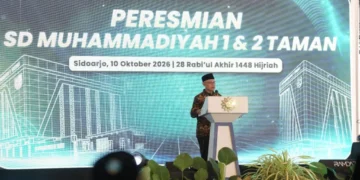
Haedar Nashir, President of Muhammadiyah, made the remarks Tuesday (18/8) during a national lecture at the Noerhadi Magetsari Multipurpose Hall at the National Archives of the Republic of Indonesia in Jakarta. 

He said Indonesia’s independence was the product of a long struggle involving every part of society. It did not come out of vacuum. Rather, it emerged from physical sacrifice as well as the intellectual and ideological efforts of the country’s founders. 

The Organizations that Prepared a Nation for Independence

One important phase of Indonesia’s national struggle began in the early 20th century. At the moment, civic, nationalist, and religious organizations began to emerge. 

These organizations did more than pursue political goals. They also established schools and health services, promoted literacy, encouraged economic self-reliance, and cultivated national consciousness. 

Haedar quoted Muhammadiyah, founded by KH Ahmad Dahlan in 1912, as one example. The organization developed a modern Islamic education system that brought together religious teachings, scientific knowledge, and a commitment to the nation. 

Over time, the movement expanded through schools, hospitals, clinics, publications, and the Hizbul Wathan scouting movement. Its women’s organization, ‘Aisyiyah, also became an important part of that development. 

Such efforts, Haedar said, helped prepare Indonesians to become a healthy, educated, and intellectually capable population that could build the newly independent nation. 

In discussing Indonesia’s system of government, Haedar explained Muhammadiyah’s view of Indonesia as a Pancasila-based state, or Darul Ahdi wa Syahadah. 

Darul Ahdi describes Indonesia as a state founded on national consensus. Meanwhile, Darul Syahadah emphasizes the responsibility of citizens to bear witness to that commitment through service and concrete contributions to the country. 

Haedar said devotion to Indonesia cannot stop at slogans about loyalty to the Unitary State of the Republic of Indonesia. It must be demonstrated through meaningful work.

“It is not enough to say that the Republic of Indonesia is non-negotiable if we do not serve it and help it advance until it stands alongside other nations,” Haedar said.

Learning from the Founders of the Republic

Haedar also recalled the example set by Indonesia’s founders when they formulated the country’s constitutional foundations.

He highlighted Ki Bagus Hadikusumo, who, together with other Muslim leaders, accepted the removal of seven words from the Jakarta Charter to preserve unity in the newly independent nation. For Haedar, that decision reflected political maturity and a willingness to place national unity above group interests.

Indonesia, he said, should therefore remain a Pancasila state. It should be neither a religious state nor a secular one, but a state grounded in Pancasila as a national consensus.

He urged Indonesians, particularly political and business elites and those entrusted with leadership, to revisit the ideas debated by the country’s founders. Before independence, he said, they engaged in extensive debates over what kind of Indonesia they wanted to build.

He pointed to the cultural debates of the 1930s, when intellectuals argued over the direction of Indonesian culture after independence. Some advocated adopting aspects of Western progress. Others proposed combining Western intellectualism with Eastern spirituality while maintaining national independence.

Similar debates took place within the Investigating Committee for Preparatory Work for Indonesian Independence, or BPUPKI, as its members discussed the foundations and future form of an independent Indonesia.

Understanding those debates remains important, Haedar said, because they can shape the state of mind with which Indonesians approach national life.

“Understanding the substance and context of those debates gives us a state of mind for how we should conduct ourselves as a nation and as a state,” Haedar said.

He argued that Indonesia would progress more quickly if its leaders, from the national government to local administrations, adopted a framework of thinking similar to that of the country’s founders.

RelatedArticle

Muhammadiyah Strengthens Peace Diplomacy in the Bangsamoro Peace Process

PCIM Tunisia Expands as Muhammadiyah Seeks to Broaden Study Opportunities for Cadres

Muhammadiyah Opens Opportunities for Islamic Education Cooperation with Cambodia

“An understanding of constitutional obligations is the foundation for anyone in the government.”

Patriotism Means Serving the Public

Haedar then returned to his central message: love of country should inspire people to give, rather than take excessive advantage of the state. For leaders, businesspeople and ordinary citizens alike, he said, patriotism should encourage people to fulfill their responsibilities and avoid actions that harm the public interest.

“Love, by its very nature, means giving, not asking, let alone stealing. True love, they say, always wants to give, not ask,” Haedar said.

He linked that principle to gratitude and love for the country. Someone who genuinely loves Indonesia, he said, would not be willing to engage in corruption, destroy natural resources or use public office for personal gain.

“If we truly love this country, we would not have the heart to commit corruption. Nor would we destroy natural resources for purposes that do not serve the public,” he said.

Haedar also urged Indonesians to keep thinking about the country’s future. Independence, he said, must be followed by self-reliance, unity, sovereignty, justice and prosperity, ideals envisioned by the nation’s founders.

The principle of Bhinneka Tunggal Ika, or “Unity in Diversity,” must also be tested in everyday life, particularly when conflicts arise between ethnic and social groups. Unity cannot remain a slogan. Instead, it must be reflected in the ability to resolve differences with maturity while preserving the integrity of the nation.

In closing, Haedar called on Indonesians to use the anniversary of independence as an opportunity to renew their sense of national responsibility. Indonesia’s progress, he said, requires a willingness to think, work and contribute according to each person’s position and responsibilities. (Taufik)

Tags: corruptionHaedar NashirIndonesiaPatriotism
ShareTweetSendShareShare
Previous Post

Muhammadiyah UK and Ireland Represents Indonesia at Global Muslim Youth Meet-Up 2026

Next Post

Flores Earthquake Relief: Redirecting Friday Prayer Donations

RelatedPosts

Haedar Nashir: Education is a Strategic Pillar for Building the Nation
Education

Haedar Nashir: Education is a Strategic Pillar for Building the Nation

28 September 2026
Haedar Nashir: Great Civilizations are Built by Prominent Figures
Figure

Haedar Nashir: Great Civilizations are Built by Prominent Figures

28 September 2026
Haedar Nashir: Muhammadiyah Members May Pray for and Mourn the Dead
Islamic Law

Haedar Nashir: Muhammadiyah Members May Pray for and Mourn the Dead

4 September 2026
Muhammadiyah Egalitarian Tradition Must Go Hand in Hand with Reverence for Islamic Scholars
Figure

Muhammadiyah Egalitarian Tradition Must Go Hand in Hand with Reverence for Islamic Scholars

1 September 2026
Next Post
Muhammadiyah Issues Appeal for Friday Prayer Donations for Flores Earthquake Victims

Flores Earthquake Relief: Redirecting Friday Prayer Donations

Muhammadiyah Mobilizes Friday Prayer Donations for Flores Earthquake Victims

Muhammadiyah Mobilizes Friday Prayer Donations for Flores Earthquake Victims

Muhammadiyah Responds to Kalimantan Wildfire 

Muhammadiyah Responds to Kalimantan Wildfire 

Populer News

  • Halal Certification in Australia: Challenges and Opportunities

    Fatwa on Using Mirin in Cooking for Muslims in Japan

    0 shares
    Share 0 Tweet 0
  • Is It Permissible for Muslims to Blow Out Birthday Candles?

    0 shares
    Share 0 Tweet 0
  • Leader’s Profile: dr. H. Agus Taufiqurrohman, Sp.S., M.Kes.

    0 shares
    Share 0 Tweet 0
  • The Islamic Character of Lionel Messi

    0 shares
    Share 0 Tweet 0
  • Man of Action, Man of Dialogue: The Legacy of KH Ahmad Dahlan

    0 shares
    Share 0 Tweet 0
  • Leader’s Profile: Drs. H. A. Dahlan Rais, M.Hum.

    0 shares
    Share 0 Tweet 0
  • Safa and Marwa: Uncovering the Historical Depths of Two Sacred Hills

    0 shares
    Share 0 Tweet 0
  • Billions in Aid: Muhammadiyah Support for Palestine

    0 shares
    Share 0 Tweet 0
  • Leader’s Profile: Prof. Dr. Haedar Nashir, M.Si.

    0 shares
    Share 0 Tweet 0
  • Can One Animal Serve Both Aqiqah and Qurban? 

    0 shares
    Share 0 Tweet 0

Council

  • Religious Opinion & Tajdid
  • Religious Preaching
  • Higher Education, Research, & Development
  • Elementary, Secondary, & Non-Formal Education
  • Cadre & Human Resources
  • Public Health
  • Social Welfare
  • Economy, Business, & Tourism
  • Waqf Utilization
  • Community Empowerment
  • Law and Human Rights
  • Enviromental Preservation
  • Publications & Information

Institutions

  • Islamic Boarding School
  • Branch & Mosque Development
  • Strategic Studies & Partnerships
  • Financial Supervision & Development
  • Disaster Management Center
  • Charity Management
  • Micro, Small, & Medium Enterprise
  • Politics & Public Policy
  • Arts & Culture
  • Sports & Development
  • International Relations & Cooperation
  • Community Da'wah
  • Halal Auditing & "Halalan Thayyiban" Studies
  • Hajj & Umroh
  • Legal Aid & Public Advocacy

Bureau

  • Organization Development
  • Financial Management
  • Communication & Public Services

Ortom

  • 'Aisyiyah Woman Association
  • Muhammadiyah Youth Association
  • Nasyiatul 'Aisyiyah Young Woman Association
  • Muhammadiyah University Student Association
  • Muhammadiyah Student Association
  • Muhammadiyah Tapak Suci Martial Arts
  • Muhammadiyah Hizbul Wathan Scouts

Sumatra Region

  • Nanggroe Aceh Darussalam
  • Sumatra Utara
  • Sumatra Selatan
  • Sumatra Barat
  • Bengkulu
  • Riau
  • Kepulauan Riau
  • Jambi
  • Bangka Belitung

Kalimantan Region

  • Kalimantan Barat
  • Kalimantan Timur
  • Kalimantan Selatan
  • Kalimantan Tengah
  • Kalimantan Utara

Jawa Region

  • D.I. Yogyakarta
  • Banten
  • DKI Jakarta
  • Jawa Barat
  • Jawa Tengah
  • Jawa Timur

Bali & Kepulauan Nusa Tenggara

Region

  • Bali
  • Nusa Tenggara Barat
  • Nusa Tenggara Timur

Sulawesi Region

  • Gorontalo
  • Sulawesi Barat
  • Sulawesi Tengah
  • Sulawesi Utara
  • Sulawesi Tenggara
  • Sulawesi Selatan

Maluku dan Papua Region

  • Maluku Utara
  • Maluku
  • Papua
  • Papua Barat
  • Papua Barat daya

Special Branch

  • Kairo Mesir
  • Iran
  • Sudan
  • Belanda
  • Jerman
  • United Kingdom
  • Libya
  • Malaysia
  • Prancis
  • Amerika Serikat
  • Jepang
  • Tunisia
  • Pakistan
  • Australia
  • Rusia
  • Taiwan
  • Tunisia
  • TurkI
  • Korea Selatan
  • Tiongkok
  • Arab Saudi
  • India
  • Maroko
  • Yordania
  • Yaman
  • Spanyol
  • Hongaria
  • Thailand
  • Kuwait
  • New Zealand

Category

  • Education
  • Health
  • Economy
  • Humanity
  • Religion
  • Law & Politics
  • Ideology
  • Culture
  • Media

About

  • History
  • Brand Guideline

Services

  • Information

Apps

  • Muhammadiyah ID
  • MASA
  • EventMu
  • BukuMu
  • SehatMu
  • KaderMu
  • LabMu

More Information

  • Editorial
  • Contact
  • Privacy Policy
© 2024 Persyarikatan Muhammadiyah

Welcome Back!

Login to your account below

Forgotten Password?

Retrieve your password

Please enter your username or email address to reset your password.

Log In

Add New Playlist

No Result
View All Result
  • icon bendera arab
  • bendera indonesia
  • EDUCATION
  • HEALTH
  • ECONOMY
  • HUMANITY
  • OTHERS
    • RELIGION
    • LAW & POLITICS
    • IDEOLOGY
    • SOCIO-CULTURE
    • ENVIRONMENT
    • MEDIA
  • Login

© 2024 Persyarikatan Muhammadiyah - Cahaya Islam Berkemajuan.