

EN.MUHAMMADIYAH.OR.ID, MANCHESTER — Muhammadiyah UK and Ireland represented Indonesia at the Global Muslim Youth Meet-Up 2026, an international gathering held at the British Muslim Heritage Centre in Manchester, England.

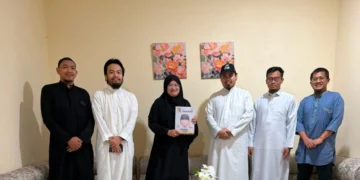
The delegation also met two prominent figures in Britain’s Muslim community. They were meeting with Manchester Lord Mayor Councillor Shaukat Ali and Wajid Akhter, Secretary General of the Muslim Council of Britain.
The meetings offered a glimpse into Manchester’s welcoming approach to its Muslim population. They also underscored the growing presence of Muhammadiyah, an Indonesian Islamic organization, in Britain.
“Our participation in the Global Muslim Youth Meet-Up 2026 affirms that Muhammadiyah, although founded in Indonesia, carries a universal mission that crosses national borders,” said Ince Dian Aprilyani Azir, Chairperson of Muhammadiyah UK and Ireland.
“Our meeting with Manchester Mayor Shaukat Ali and MCB Secretary General Dr. Wajid Akhter shows that the networks we have built in Britain are gaining recognition and trust, both from city authorities and the wider Muslim community,” she added.
Young Muslim and the Lessons of Islamic History
The forum, initiated by Yosh International in partnership with MyFundAction, brought together young Muslim delegates from several countries, including Malaysia, Jordan, Egypt, Turkey, Ireland, and Britain.
Together, they discussed the future direction of Muslim youth movements. Meanwhile, a series of conferences and workshops prompted the Muhammadiyah delegation to reflect on youth leadership and the emerging Islamic business ecosystem.
One discussion focused on finding inspiration in prominent figures from Islamic history. Participants examined the lives of three figures: Ali ibn Abi Talib who embraced Islam and affirmed his faith at a young age; Mus’ab ibn Umair, a young diplomat who helped bring Islam to Medina; and Ibn Abbas, who devoted his youth to the pursuit of religious knowledge, or tafaqquh fiddin.
“The central discussion affirmed that being young is not simply a matter of biological age. It is about commitment, capacity and meaningful contribution. The sirah shows that the foundations of Islamic preaching were often laid by young people.”
The forum then turned to social entrepreneurship and its potential to reshape Muslim business practices. Participants identified four principles for transformation.
The first was a shift from competition to cooperation, replacing destructive rivalry with greater collaboration among businesses. The second called for a move toward a “slow economy” encouraging consumers to replace instant consumption with more deliberate choices. The third was a shift from consumers to producers. Muslims, the participants argued, should move beyond consumption toward creating solutions and supporting philanthropy through infaq.
Finally, the forum discussed a transition from scarcity to abundance. The principle rests on the Islamic belief that God created the Earth with sufficient resources to meet human needs. Current scarcity, participants argued, often results not from a lack of resources but from unequal distribution and excessive human wants.
Sustaining Muslim Leadership Through Innovation
The final major discussion centered on sustainable innovation within Islamic institutions. Participants argued that innovation has become essential if younger generations are to remain confident in their Muslim identity amid rapid social change. For Ince, the forum also carried a broader message about Muslim influence around the world: it must continue to circulate across generations.
“Good leaders must keep moving, developing others and mentoring their successors,” she said. “There was also a striking reflection at the end of the forum: Only impostors never experience impostor syndrome.” She said a healthy sense of self-doubt can instead indicate that a leader continues to learn, reflect and protect their integrity.
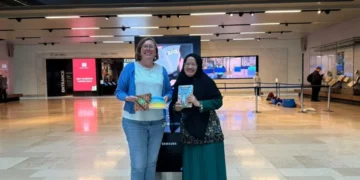
The Muhammadiyah delegation consisted of Ince Dian Aprilyani Azir, chairwoman; Farisah Amanda, secretary of the Council for Libraries, Information and Communication; and Aidan Maulana, a young member of Muhammadiyah in Britain.
Their participation as Indonesia’s sole delegation, along with meetings with Manchester’s mayor and the secretary-general of the Muslim Council of Britain, is expected to expand Muhammadiyah’s international network in Europe. The engagement is to strengthen ties with Manchester authorities and Britain’s wider Muslim community. Meanwhile, the lessons drawn from Manchester will be developed as resources for Muhammadiyah’s cultural outreach and youth empowerment efforts, in line with its vision of Progressive Islam through social progress. (Bhisma)