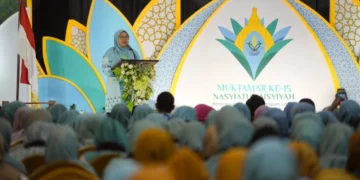


MUHAMMADIYAH.OR.ID, MAKASSAR – President of Muhammadiyah Central Board, Haedar Nashir, delivered an address at the opening of the 24th Muktamar National Congress of Muhammadiyah Student Association (IPM) at Muhammadiyah University of Makassar on Friday (06/02).

“I am the President of Muhammadiyah Central Board, but I am also an IPM alumnus.” He recalled his long journey in the organization from IPM in SMA N 10 Bandung (1975–1977), IPM in the Special Region of Yogyakarta, to the Central Board of IPM (1983–1986).
Muhammadiyah as a Collective Home
Haedar emphasized that all Muhammadiyah autonomous organizations—‘Aisyiyah, Pemuda Muhammadiyah, IPM, IMM, Nasyiatul ‘Aisyiyah, Hizbul Wathan, and Tapak Suci—form one collective home that strengthens the Muhammadiyah movement.
“At 113 years old, Muhammadiyah has reached every corner of Indonesia, including frontier regions, and expanded globally through schools, universities, da’wah centers, and dozens of PCIM abroad,” he said.
He, moreover, highlighted Muhammadiyah’s vast network of schools, universities, hospitals, and clinics. It is a concrete manifestation of its service to society, urging IPM to ensure the congress produces real impact for the organization, the ummah, and the nation.
Faith, Knowledge, and the Spirit of Renewal
Haedar invited the audience to reflect on IPM’s slogan “Nuun wal-qalami wa maa yasthurun” (“By the pen and what they write”). He stressed that the movement must be rooted in faith (iman), righteous deeds (amal), piety (taqwa), and monotheism (tauhid).
“Progress and achievement will be meaningless if these values are detached from our movement,” he warned.
He also underscored the importance of knowledge, competence, and reformist thinking.
“You must not act or speak without knowledge. Indonesia’s future depends on strong traditions of learning, critical thinking, and renewal,” Haedar said.
Finally, Haedar described Muhammadiyah’s youth as Dahlan Muda Pembaharu. He refer to it as young reformers who must dedicate their faith and knowledge to serving humanity.
“A reformer is like an eagle—flying high and spreading the spirit of change wherever it lands,” he concluded. (Bhisma)