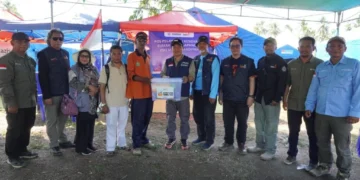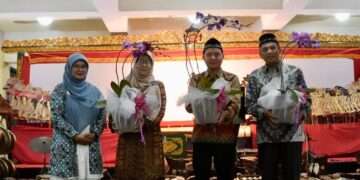


EN.MUHAMMADIYAH.OR.ID, JAKARTA – The Central Board of Muhammadiyah welcomed a delegation from Singapore’s Islamic Religious Council (Majlis Ugama Islam Singapura/MUIS) to exchange views on Islamic outreach, human-resource development, philanthropy, and the growing elderly population in Indonesia and Singapore.

The MUIS delegation included Deputy Director Alfian Yasrif Bin Kuchit and Senior Executive Goh Muhammad Redhuan. Muhammadiyah Central Board was represented by its Treasurer Hilman Latief. He was accompanied by Muhammadiyah Central Board Tabligh Council Member Reza Prima Matondang, and Lazismu Chairperson Ahmad Imam Mujadid Rais.
Hilman said Islamic outreach in Indonesia requires different approaches because communities have diverse social and religious characteristics. This diversity is also reflected in Muhammadiyah’ educational institution, which serve both Muslim and non-Muslim students.
“Many of our schools have non-Muslim students, as do our universities. We even have what we call Krismuha, or Christian-Muhammadiyah. They are expected to understand Al-Islam and Muhammadiyah,” Hilman said.
Responding to an Aging Population
The meeting also highlighted the growing elderly population as an emerging challenge for Islamic outreach. Hilman said Muhammadiyah and ‘Aisyiyah are exploring models of outreach specifically designed for older people, including elder’s Islamic boarding schools.
“‘Aisyiyah in particular is enthusiastic about establishing Islamic Boarding schools for the elderly. We have looked at Singapore and other countries, where the elderly population is growing. We have not taken this issue seriously enough. Outreach to this group must become a priority,” he said.
Reza welcomed the proposal, saying the growing elderly population presents an opportunity for Islamic organizations to develop programs addressing older people’s spiritual and social needs.
“Given the growing elderly population, it is excellent that Prof. Hilman has proposed making outreach to older people a priority,” Reza said.
Beyond elderly outreach, Reza called for stronger networks among young Southeast Asian figures involved in Islamic outreach. He said Muhammadiyah and MUIS could develop joint training and camps for young religious teachers across the region.
“We also want to establish a camp and joint training for young religious teachers from Southeast Asia,” he said.
The program, he added, would equip young preachers not only with religious knowledge but also with the ability to understand social change and develop solutions that benefit society.
MUIS Looks to Muhammadiyah’s Institutional Experience
Alfian said MUIS was interested in Muhammadiyah’s experience managing an extensive network of hospitals, universities, schools, and charitable institutions.
“We came to Muhammadiyah to learn because it has units such as hospitals, universities, and schools. Singapore does not yet have an organization like this,” he said.
He added that MUIS was particularly interested in Muhammadiyah’s approach to developing religious teachers and preachers who can manage large institutions and ensure organizational regeneration.
Alfian also highlighted ‘Aisyiyah’s work in advancing women’s interests and the Muhammadiyah Council for Religious Opinion and Reform, which develops religious guidance while considering public benefit.
The two sides also discussed philanthropy. Reza noted that Singapore has several philanthropic initiatives that could provide lessons for Muhammadiyah and other Islamic organizations in Indonesia, while MUIS expressed appreciation for the growth of philanthropy in Indonesia, particularly through Muhammadiyah’s Lazismu.
Pertemuan Muhammadiyah dan MUIS tersebut juga membahas perkembangan filantropi di kedua negara. Reza menyampaikan bahwa Singapura memiliki sejumlah proyek filantropi yang dapat menjadi bahan pembelajaran bagi Muhammadiyah dan organisasi Islam di Indonesia. Sebaliknya, MUIS juga memberikan apresiasi terhadap perkembangan filantropi di Indonesia, khususnya yang dikembangkan Muhammadiyah melalui Lazismu.
The meeting is expected to strengthen Muhammadiyah-MUIS cooperation in Islamic outreach, human-resource development, philanthropy, and responses to social and demographic changes across Southeast Asia. (Taufik)