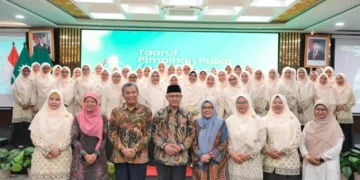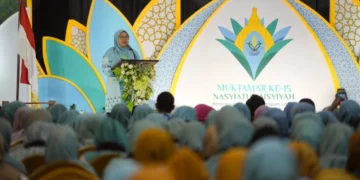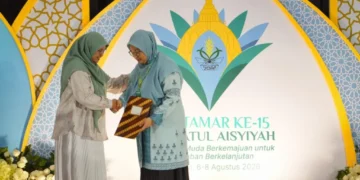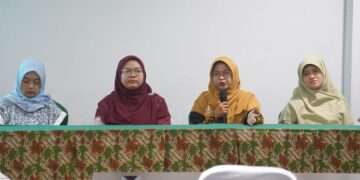


EN.MUHAMMADIYAH.OR.ID, SURAKARTA – The 15th National Congress (Muktamar XV) of Nasyiatul ‘Aisyiyah (NA) continued with Strategic Forum I, titled “Strengthening Young Women’s Capacity in the Society 5.0 Era: Advancing Gender-Responsive Policies,” at Dwangsa Loring Hotel in Surakarta on Friday afternoon (7/8).

The forum featured Stella Christie, Indonesia’s Deputy Minister of Higher Education, Science, and Technology, and Iffa Rosita, a member of the General Elections Commission. Both speakers examined challenges facing young women amid rapid developments in technology, education, democracy, and politics.
As the first speaker, Stella Christie highlighted the persistent gender gap in Science, Technology, Engineering, and Mathematics (STEM). She said the disparity does not simply stem from differences in ability. Instead, deeply rooted social biases and stereotypes continue to shape women’s opportunities.
“In Indonesia, women account for only around 12% of STEM graduates, compared with 29% for men,” Stella said while discussing the country’s STEM workforce.
She explained that the belief that men are more suited to science and technology has shaped social perceptions. As a result, such perceptions influence women’s educational choices and career paths.
“Why is that? It is not because of natural ability. Rather, it is because of the biases and stereotypes within our society,” she stressed.
AI Can Reinforce Existing Gender Bias
Stella then connected the issue to the development of artificial intelligence (AI). Albeit AI is often regarded as objective, she said it can reinforce inequality when trained on data that already contains bias.
For example, she referred to an AI-based recruitment system once developed by Amazon. The system was eventually discontinued after it showed a tendency to favor male candidates over female candidates.
“Although AI has no feelings, it uses data. If the data contains more patterns associated with male candidates, then more male CVs will be selected. AI can still be biased because it relies on data,” Stella explained.
Therefore, Stella argued that technology alone cannot solve gender inequality. Instead, society must address the biases embedded within it. She urged Nasyiatul Aisyiyah members to expand women’s participation in STEM and help create a more inclusive environment.
“The solution is not AI. We, as influential communities, have a responsibility to reduce stereotypes. If these gender biases can be addressed, the impact will be felt directly in the economy,” she said.
Increasing Young Women’s Political Contribution
Meanwhile, KPU member Iffa Rosita encouraged young women to strengthen their role in Indonesia’s democratic and political life. According to Iffa, the challenges extend beyond unequal access and digital literacy. They also include gender stereotypes, patriarchal culture, low female representation, and widespread disinformation in the public sphere.
She stressed that women’s political participation must go beyond election periods. Young women should take part in every stage of democracy. This includes exercising their voting rights, monitoring government performance, voicing concerns, influencing public policy, and becoming decision-makers themselves.
“We are important actors in determining what Indonesia will look like in the future. By continuing to participate actively, we hope to nurture intelligent women who can make informed choices and help prepare and shape the next generation of leaders,” Iffa said.
Strategic Forum I served as a space for reflection and capacity building for Nasyiatul Aisyiyah members as they confront the challenges of the Society 5.0 era. In line with the theme of the 15th Nasyiatul Aisyiyah Congress, “Young Women of Progress for a Sustainable Civilization,” the forum affirmed that young women must do more than adapt to technological advances.
They must also become key actors in driving innovation, dismantling gender bias, and advancing policies that are more inclusive and equitable for all members of society. (Bhisma)