Thursday, October 1, 2026
  • AR
  • ENG
  • IDN
Muhammadiyah Media
  • EDUCATION
  • HEALTH
  • ECONOMY
  • HUMANITY
  • OTHERS
    • RELIGION
    • LAW & POLITICS
    • IDEOLOGY
    • SOCIO-CULTURE
    • ENVIRONMENT
    • MEDIA
No Result
View All Result
  • Login
Muhammadiyah Media
  • EDUCATION
  • HEALTH
  • ECONOMY
  • HUMANITY
  • OTHERS
    • RELIGION
    • LAW & POLITICS
    • IDEOLOGY
    • SOCIO-CULTURE
    • ENVIRONMENT
    • MEDIA
No Result
View All Result
  • Login
Muhammadiyah Media
No Result
View All Result
  • EDUCATION
  • HEALTH
  • ECONOMY
  • HUMANITY
  • OTHERS
Home Ideology

PHIWM Reinforces Tawhid as the Foundation of Muhammadiyah Life

by Persyarikatan Muhammadiyah
3 months ago
in Ideology, News
Reading Time: 5 mins read
A A
PHIWM Reinforces Tawhid as the Foundation of Muhammadiyah Life

PHIWM Reinforces Tawhid as the Foundation of Muhammadiyah Life

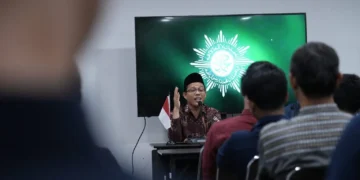
EN.MUHAMMADIYAH.OR.ID, YOGYAKARTA — A member of the Central Board of Muhammadiyah’s Council for Religious Preaching, Talqis Nurdianto, has called on Muhammadiyah members to embrace the Guidance for the Islamic Life of Muhammadiyah Members (Pedoman Hidup Islami Warga Muhammadiyah/PHIWM) as a practical framework for living according to Islamic teachings. 

Talqis said the PHIWM helps Muslims implement the teachings of the Qur’an and the Sunnah in a systematic and practical way across different aspects of life. 

He delivered the message at a religious study session at KH Sudja Mosque in Yogyakarta on Thursday (2/7). The lecture marked the first session in a series that will examine the PHIWM chapter by chapter. 

PHIWM is Not a Substitute to the Qur’an and the Sunnah

Talqis emphasized that the guidelines do not replace the Qur’an and the Sunnah. Instead, they organize their teachings into thematic guidance based on Muhammadiyah’s official documents, including the Corpus of creed and Life Goals of Muhammadiyah (Matan Keyakinan dan Cita-Cita Hidup Muhammadiyah/MKCH), the Preamble to the Statute of Muhammadiyah (Muqadimah Anggaran Dasar Muhammadiyah), the Identity of Muhammadiyah (Kepribadian Muhammadiyah) and the Tract of Muhammadiyah (Khittah Muhammadiyah).

“The PHIWM makes it easier for us to practice the teachings of the Qur’an and the hadith because they are presented thematically. It does not replace the Qur’an or the Sunnah. Rather, it serves as a practical guide for Muhammadiyah members,” he said. 

He also encouraged members to approach any perceived shortcomings in the document through scholarly dialogue and tabayyun (careful verification) instead of making unilateral judgment on social media. Because the guidelines were man-made, he noted, they remain open to refinement, while the Qur’an and the Sunnah remain the ultimate sources of authority. 

Talqis explained that the need for the PHIWM originated from a mandate issued during the Muhammadiyah Tanwir meeting in Jakarta in 1992. Although the document was produced decades ago, he said its principles remain relevant because they are rooted in Islamic scripture. 

“Generations may change, from Millennials to Gen Z and Gen Alpha, but as long as the foundation remains the Qur’an and the Sunnah, these guidelines will remain relevant,” he said. 

The PHIWM covers a wide range of topics, including personal conduct, family life, community engagement, organizational ethics, the management of Muhammadiyah Social Enterprises, business, professional responsibilities, citizenship, environmental stewardship, science and technology, and perspective on arts and culture. 

According to Talqis, this breadth reflects Islam’s comprehensive guidance. Islamic law extends beyond ritual worship into social, professional, and civic life. 

Building Character through Faith

Talqis outlined the spiritual development described in the PHIWM. It began with becoming a Muslim, mu’min (believer), muhsin (one who excels in worship), and ultimately muttaqi (God-conscious person).

He said the declaration of faith is more than a verbal statement. Affirming that there is no deity but Allah requires believers to reject every form of misplaced devotion, while acknowledging Muhammad as His Messenger means following his example. 

Talqis cautioned Muslims against belittling the Prophet’s Sunnah. While failing to perform recommended acts of worship does not constitute sin, he said, disparaging the Sunnah reflects a lack of genuine love for the Prophet. 

He also stressed that sound religious knowledge is essential for developing steadfast faith capable of withstanding doubt. 

According to Talqis, a true believer responds to Allah’s command with sami’na wa ata’na (we hear and we obey) without unnecessary conditions or bargaining. A muhsin, meanwhile, worships sincerely for Allah alone rather than seeking public recognition. 

“If we perform good deeds only because people are watching, then we have not yet reached the level of ihsan,” he said. 

A muttaqi, he added, constantly remains aware of Allah’s presence. They diligently fulfill His commands, avoid His prohibitions, and regularly evaluates personal conduct. 

Tawhid at the Center of Daily Life

Talqis then discussed the four pillars of personal life outlined in the PHIWM: creed (aqidah), character (akhlaq), worship (ibadah), and worldly affairs (muamalah duniawiyah).

In matters of faith, he said Muhammadiyah members must build their lives upon pure tawhid, or the oneness of God. Citing Surah Al-Ikhlas, he explained that this principle requires Muslims to reject superstition, innovations in ritual worship without scriptural basis, myths, and mystical beliefs.

As examples, he referred to traditions such as determining marital compatibility through Javanese weton calculations or believing that certain numbers bring fortune or misfortune.

“Muhammadiyah members believe in the existence of jinn because the Qur’an affirms it. However, we must never associate good or bad fortune with trees, numbers, or mystical calculations,” he said.

Turning to ethics, Talqis encouraged members to emulate the Prophet Muhammad’s qualities of honesty (siddiq), trustworthiness (amanah), effective communication (tabligh), and wisdom (fathanah). He argued that honesty is indispensable in both business and public life, since trust, once broken, is difficult to restore.

He also underscored the importance of sincerity, warning that disappointment over a lack of recognition often signals that one’s intentions require purification. Furthermore, he urged Muhammadiyah members to avoid arrogance, ostentation, contempt for others, promiscuity, consumerism, corruption, collusion, and other forms of moral misconduct.

RelatedArticle

Muhammadiyah Strengthens Peace Diplomacy in the Bangsamoro Peace Process

PCIM Tunisia Expands as Muhammadiyah Seeks to Broaden Study Opportunities for Cadres

Muhammadiyah Opens Opportunities for Islamic Education Cooperation with Cambodia

Regarding worship, Talqis encouraged Muslims to prioritize obligatory acts before increasing voluntary devotions, emphasizing repentance, seeking forgiveness, and spiritual purification.

“Do not become diligent in night prayers while neglecting the dawn prayer. Obligatory worship must always come first,” he said. 

Finally, in discussion muamalah duniawiyah, Talqis reminded participants that Muslims are both servants of Allah and stewards of the earth. Consequently, economic activity, professional work, and the management of natural resources should always be carried out responsibly and without causing environmental harm. 

Tags: Muhammadiyah ideologytarjih council
ShareTweetSendShareShare
Previous Post

World Cup 2026 Predictions and the Islamic Warning Against Superstition

Next Post

Lamine Yamal Raising His Hands in Prayer: What Does Islam Say?

RelatedPosts

Argentina and Egypt Controversy from Paul Ricoeur’s Hermeneutics Perspective
News

Argentina and Egypt Controversy from Paul Ricoeur’s Hermeneutics Perspective

10 July 2026
Rofiq Muzakir: LGBTQ is a Global Threat
Figure

Rofiq Muzakir: LGBTQ is a Global Threat

7 July 2026
Muhammadiyah Does Not Align Itself with Any Single Madhhab
Islamic Law

Muhammadiyah Does Not Align Itself with Any Single Madhhab

6 July 2026
Muhammadiyah Ideology: The Pillars of Faith, Morality, and Intellectual Growth
Ideology

Muhammadiyah Ideology: The Pillars of Faith, Morality, and Intellectual Growth

26 August 2024
Next Post
This reconciliatory approach

Lamine Yamal Raising His Hands in Prayer: What Does Islam Say?

Living with In-Laws? Here's Islam’s Guidance for Building a Harmonious Family

Living with In-Laws? This is the Islamic Guidance

Child Marriage Creates a Cycle of Problems That Must Be Broken

Child Marriage Creates a Cycle of Problems That Must Be Broken

Populer News

  • Halal Certification in Australia: Challenges and Opportunities

    Fatwa on Using Mirin in Cooking for Muslims in Japan

    0 shares
    Share 0 Tweet 0
  • Is It Permissible for Muslims to Blow Out Birthday Candles?

    0 shares
    Share 0 Tweet 0
  • The Islamic Character of Lionel Messi

    0 shares
    Share 0 Tweet 0
  • Leader’s Profile: Drs. H. A. Dahlan Rais, M.Hum.

    0 shares
    Share 0 Tweet 0
  • Safa and Marwa: Uncovering the Historical Depths of Two Sacred Hills

    0 shares
    Share 0 Tweet 0
  • Leader’s Profile: dr. H. Agus Taufiqurrohman, Sp.S., M.Kes.

    0 shares
    Share 0 Tweet 0
  • Man of Action, Man of Dialogue: The Legacy of KH Ahmad Dahlan

    0 shares
    Share 0 Tweet 0
  • Leader’s Profile: Prof. Dr. Haedar Nashir, M.Si.

    0 shares
    Share 0 Tweet 0
  • Can One Animal Serve Both Aqiqah and Qurban? 

    0 shares
    Share 0 Tweet 0
  • Is It Permissible to Listen to Songs Sung by Women?

    0 shares
    Share 0 Tweet 0

Council

  • Religious Opinion & Tajdid
  • Religious Preaching
  • Higher Education, Research, & Development
  • Elementary, Secondary, & Non-Formal Education
  • Cadre & Human Resources
  • Public Health
  • Social Welfare
  • Economy, Business, & Tourism
  • Waqf Utilization
  • Community Empowerment
  • Law and Human Rights
  • Enviromental Preservation
  • Publications & Information

Institutions

  • Islamic Boarding School
  • Branch & Mosque Development
  • Strategic Studies & Partnerships
  • Financial Supervision & Development
  • Disaster Management Center
  • Charity Management
  • Micro, Small, & Medium Enterprise
  • Politics & Public Policy
  • Arts & Culture
  • Sports & Development
  • International Relations & Cooperation
  • Community Da'wah
  • Halal Auditing & "Halalan Thayyiban" Studies
  • Hajj & Umroh
  • Legal Aid & Public Advocacy

Bureau

  • Organization Development
  • Financial Management
  • Communication & Public Services

Ortom

  • 'Aisyiyah Woman Association
  • Muhammadiyah Youth Association
  • Nasyiatul 'Aisyiyah Young Woman Association
  • Muhammadiyah University Student Association
  • Muhammadiyah Student Association
  • Muhammadiyah Tapak Suci Martial Arts
  • Muhammadiyah Hizbul Wathan Scouts

Sumatra Region

  • Nanggroe Aceh Darussalam
  • Sumatra Utara
  • Sumatra Selatan
  • Sumatra Barat
  • Bengkulu
  • Riau
  • Kepulauan Riau
  • Jambi
  • Bangka Belitung

Kalimantan Region

  • Kalimantan Barat
  • Kalimantan Timur
  • Kalimantan Selatan
  • Kalimantan Tengah
  • Kalimantan Utara

Jawa Region

  • D.I. Yogyakarta
  • Banten
  • DKI Jakarta
  • Jawa Barat
  • Jawa Tengah
  • Jawa Timur

Bali & Kepulauan Nusa Tenggara

Region

  • Bali
  • Nusa Tenggara Barat
  • Nusa Tenggara Timur

Sulawesi Region

  • Gorontalo
  • Sulawesi Barat
  • Sulawesi Tengah
  • Sulawesi Utara
  • Sulawesi Tenggara
  • Sulawesi Selatan

Maluku dan Papua Region

  • Maluku Utara
  • Maluku
  • Papua
  • Papua Barat
  • Papua Barat daya

Special Branch

  • Kairo Mesir
  • Iran
  • Sudan
  • Belanda
  • Jerman
  • United Kingdom
  • Libya
  • Malaysia
  • Prancis
  • Amerika Serikat
  • Jepang
  • Tunisia
  • Pakistan
  • Australia
  • Rusia
  • Taiwan
  • Tunisia
  • TurkI
  • Korea Selatan
  • Tiongkok
  • Arab Saudi
  • India
  • Maroko
  • Yordania
  • Yaman
  • Spanyol
  • Hongaria
  • Thailand
  • Kuwait
  • New Zealand

Category

  • Education
  • Health
  • Economy
  • Humanity
  • Religion
  • Law & Politics
  • Ideology
  • Culture
  • Media

About

  • History
  • Brand Guideline

Services

  • Information

Apps

  • Muhammadiyah ID
  • MASA
  • EventMu
  • BukuMu
  • SehatMu
  • KaderMu
  • LabMu

More Information

  • Editorial
  • Contact
  • Privacy Policy
© 2024 Persyarikatan Muhammadiyah

Welcome Back!

Login to your account below

Forgotten Password?

Retrieve your password

Please enter your username or email address to reset your password.

Log In

Add New Playlist

No Result
View All Result
  • icon bendera arab
  • bendera indonesia
  • EDUCATION
  • HEALTH
  • ECONOMY
  • HUMANITY
  • OTHERS
    • RELIGION
    • LAW & POLITICS
    • IDEOLOGY
    • SOCIO-CULTURE
    • ENVIRONMENT
    • MEDIA
  • Login

© 2024 Persyarikatan Muhammadiyah - Cahaya Islam Berkemajuan.