

MUHAMMADIYAH.OR.ID, YOGYAKARTA – One of the unique features of Ramadan fasting lies in its invisibility. Unlike prayer or other visible rituals, fasting leaves no outward sign. A person may even appear to sleep while still doing it. Therefore, integrity stands at the heart of the practice.

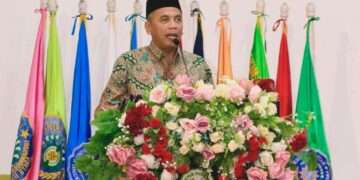
Agung Danarto, Chairperson of Muhammadiyah Central Board, delivered that message on (17/2) at KH Ahmad Dahlan Mosque located at Muhammadiyah University of Yogyakarta.
“When we fast, are we truly fasting or have we already broken it?” he asked. “No one knows except ourselves and Allah.”
An Inner Discipline
For Danarto, Ramadan functions as an extraordinary school for character building, especially in cultivating integrity. Because fasting remains unseen, those who observe it cannot rely on public recognition. Instead, they act without applause.
All acts of worship, he said, should aim at one goal: seeking God’s pleasure alone. A believer should not pursue praise from others. Rather, he must guard himself in solitude and prove his integrity as a servant devoted to God.
He linked this idea to the classical triad of faith: iman, Islam, and ihsan. Integrity in fasting, he suggested, belongs to the realm of ihsan, or spiritual excellence.
Fasting, therefore, trains not only integrity but also honesty. Every Muslim, indeed every believer, receives that training each Ramadan.
A Moral Question for Society
Yet, Danarto raised a troubling question. Many Indonesian Muslims have fasted since childhood. Still, corruption and other moral failures persist.
“Those who fast during Ramadan should distinguish clearly between truth and falsehood,” he said. “A person of integrity naturally supports what is good and stands against what is wrong.”
If a Muslim shows no inclination toward justice and goodness, he added, then others may reasonably question the depth of his faith.
For that reason, Danarto called on Muslims to treat Ramadan as a true “madrasah of integrity.” The lessons, he argued, should extend beyond personal piety. They should shape social, cultural, economic and political life as well.