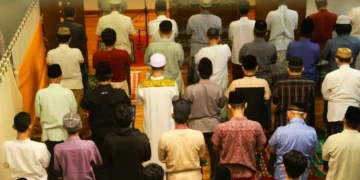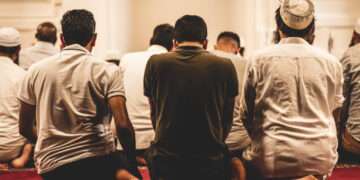


MUHAMMADIYAH.OR.ID, JAKARTA – From a fiqh (jurisprudence) perspective, Tarawih is considered an ibadah mahdhah. It is a form of worship whose time and manner of performance have already been clearly determined and standardized.

General Secretary of Muhammadiyah Central Board, Abdul Mu’ti, delivered the message in the program “Jendela Ramadan: Salat Tarawih” part 2, broadcast on the TvMu Youtube Channel.
“It is called ibadah mahdhah because it cannot be performed outside the holy month of Ramadan. Secondly, in terms of its implementation, this prayer is performed after the Isya prayer and before the Fajr prayer. Therefore, it cannot be carried out outside that time frame,” Mu’ti said during the broadcast on Thursday (5/5).
Derived from the Word Raha (رَاحَ) : Rest or Relaxation
Some people feel that performing Tarawih takes a long time, and it is not uncommon to hear complaints of fatigue due to the relatively large number of rakaat. However, when examined linguistically, the word Tarawih itself derives from the word raha (رَاحَ) which means rest or relaxation.
The Muhammadiyah leader then elaborated on three reasons why the prayer is described as a relaxed form of prayer.
First reason viewed from the historical context. Prophet Muhammad received the instruction of Tarawih near the end of his life, around the age of sixty. Some scholars even state that he was older than sixty.
“Several narrations mention that his practice of Tarawih was relaxed. He would perform some units of prayer, then rest, pause, and then continue again,” Mu’ti explained.
The Prophet’s Practice and the Wisdom Behind It
The second reason relates to the Prophet’s practice of performing Tarawih at the mosque. According to Mu’ti, the Prophet led the night prayer in congregation at the mosque only once. On subsequent nights, some companions waited for him in the mosque for quite a long time because he did not come out of his house to lead the prayer again.
“Seeing that some companions were waiting, the Prophet said, ‘I deliberately did not come out of my house. If i had come out, you would have considered the Tarawih prayer to be obligatory.’ Because of that, its ruling is sunnah and it does not have to be performed in the mosque,” he said.
Finally, Mu’ti explained that Tarawih is associated with the meaning of “rest” because of the length and flexibility of its time of performance. As explained earlier, Tarawih can be performed after the Isya prayer until before the Fajr prayer. Therefore, the time for performing Tarawih is quite broad.
“Some perform it immediately after Isya, while others perform it in the middle of the night during the time of tahajud. Because of this, some scholars categorize Tarawih as part of qiyamul lail (night prayers). Therefore, its time is very flexible,” Mu’ti concluded.
From this explanation, it can be understood that Tarawih prayer carries not only a devotional dimension but also values of tranquility, spaciousness of time, and ease for Muslims. The meaning of “rest” embedded in Tarawih teaches that this worship should be performed with full concentration and serenity, without haste, while taking into account each person’s capability. (Bhisma)