

MUHAMMADIYAH.OR.ID, JAKARTA – Muhammadiyah must not be left behind in the development of information technology, especially with the rise of artificial intelligence (AI). However, any progress achieved must not come at the cost of losing touch with cultural and religious traditions.

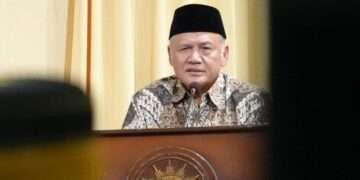
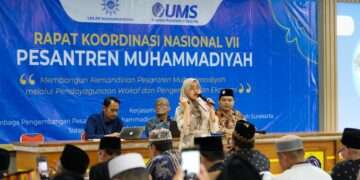
The Secretary-General of the Central Board of Muhammadiyah, Abdul Mu’ti, delivered this message on Saturday (24/01) during a Islamic Lecture at its Jakarta Headquarters.
“Technological sophistication must not uproot us from our traditions. The Qur’an must continue to be studied and contextualized using advanced knowledge,” he said.
Abdul Mu’ti emphasized that AI is capable of explaining many aspects of human life. AI can now describes or analyzed nearly all forms of human activity and work, he noted.
“AI can explain why humans develop cancer. It can do so very quickly,” he explained. “But AI cannot conduct research on how to cure the illness.”
He also highlighted AI’s limitations in social and religious domains that require empathy. According to Mu’ti, AI may possess intelligence (the mind), but it lacks the heart.
“The head relates to cognitive and metacognitive knowledge. The hand relates to skills. And then, there is the heart. In the end, AI is all head,” explains Mu’ti.
In the context of 21st century education, Mu’ti stressed the importance of balancing head, hand, and heart. These three dimensions must be developed in harmony, otherwise, instead of being empowered, humans risk becoming addicted to technology.
In his remarks, Abdul Mu’ti also referred to a tragic case involving a teenager in the United States who became overly dependent on AI technology. He recounted that AI, in this case ChatGPT, left a 15 year old child in despair after it could not reciprocate the child’s feelings.
“He fell in love with ChatGPT, but ChatGPT said, ‘I cannot return your love.’ The child became desperate and eventually took his own life,” Mu’ti said.
The incident, he argued, should serve as a serious warning in responding to technological advancement. Mastery of technology is essential, but humans must not allow themselves to be controlled by it.