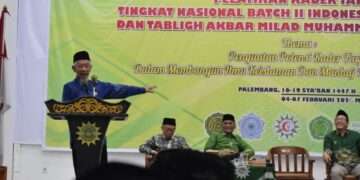


MUHAMMADIYAH.OR.ID, YOGYAKARTA – Chairperson of Muhammadiyah Central Board, Saad Ibrahim, asserts that tauhid (monotheism) represents the pinnacle of Islamic teaching. Moreover, he describes it as the spiritual engine driving the organization’s missionary work and social enterprises.

Saad Ibrahim delivered these remarks during the first session of the 1447 H Ramadan Sermon hosted by Muhammadiyah Central Board. The session, titled “Genealogy of Creedal Thought in Muhammadiyah: A Review of Classical Islamic Theology,” took place on Friday (20/2)
Saad explained that shirk (idolatry) stands as the direct opposite of tauhid. According to his explanation, it remains a sin that God does not forgive unless the individual repents before embracing Islam
He referenced the word of Allah in Surah An-Nisa, verses 48 and 116, which state that Allah does not forgive the sin of shirk. Furthermore, he cited Surah Al-Anbiya, verse 29, regarding the consequences for anyone claiming divinity besides Allah.
“Whoever among them says, ‘Indeed, I am a god besides Him,’ that person We will recompense with Hell. Thus do We recompense the wrongdoers,” he clarified while quoting the verse.
The Chairperson also provided a brief historical overview of how idolatrous practices emerged within human civilization. He noted that from the era of Prophet Adam to Prophet Noah, the teachings of monotheism remained firm. However, as generations passed, humans began creating statues. While these figures initially served as mere reminders of pious figures, they eventually transformed into objects of worship. Consequently, this historical shift illustrates the constant struggle between pure faith and spiritual deviation.
“Here is where we see the historical journey of shirk, which is the opposite of tauhid,” he remarked.
Tauhid as the Foundation of Muhammadiyah Movement
In the second half of his address, Saad urged all members of the organization to abandon all forms of idolatry. He encouraged them to solidify tauhid as the basis of both Islamic and Muhammadiyah teachings. “Monotheism is the root and the head of religious teachings. From this understanding of tauhid, the entire structure of Muhammadiyah’s thought and movement rests,” he asserted.
He believes that the spirit of progress within Muhammadiyah’s social enterprises is rooted deeply in monotheism. Muhammadiyah relies heavily on its specific understanding of Islam. For the organization, Islam is inherently a progressive religion. This perspective creates a unique model of development. Therefore, this understanding gives birth to movements and social works that prioritize progress by using Islam as the primary foundation.
Consequently, Saad believes that the concept of progress in Muhammadiyah is not a secular advancement. Instead, it is a progress rooted strongly in the teachings of tauhid that form the “Progressive Islamic Creed.” By standing on a firm foundation of monotheism and avoiding all forms of shirk, the movement remains confident. The direction of Muhammadiyah’s thoughts and social developments will surely be able to answer the challenges of the future. (Bhisma)