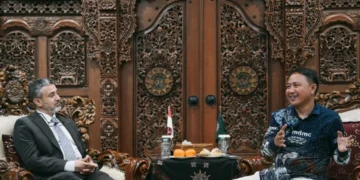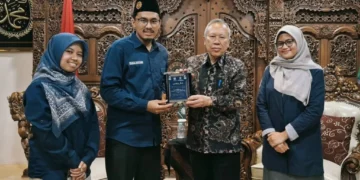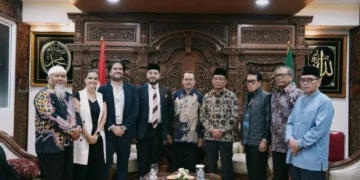


MUHAMMADIYAH.OR.ID, JAKARTA – The Central Board of Muhammadiyah received a visit from the Rector of Jamiah Al Mustafa Al-Alamiyah (JMIA), Ali Abbasi.

The visit marked an important milestone in strengthening the relationship between the two major Islamic institutions, both of which play strategic roles in education and the development of modern Islamic civilization.
Rector Ali Abbasi expressed his deep appreciation for Muhammadiyah’s century-long contribution to the revival of Islam in Indonesia, highlighting its consistent efforts to integrate Islamic teachings with social development and education.
“Muhammadiyah has consistently upheld its commitment to combining Islamic values with social and educational advancement, along with its vision of contributing to the revival of Islamic civilization,” Abbasi stated during the meeting on Thursday (6/11)
He further emphasized JMIA’s belief that through the collaboration of both institutions, especially in the field of education, they can foster the growth of knowledge, character, faith, and global understanding.
According to Abbasi, a progressive and modern interpretation of Islam does not mean abandoning tradition. Instead, it builds upon tradition as a moral and spiritual foundation for facing the challenges of modernity. He explained that JMIA has developed various educational approaches, from classical turath-based studies to contemporary research in social, political, and international relations fields, guided by a spirit of integrating knowledge and values.
A Bridge Between Iran and Indonesia
Abbasi also expressed his hope that the cooperation between JMIA and Muhammadiyah will continue to expand across multiple areas. These include faculty and student exchanges, joint research projects, inter-civilizational dialogues, and the development of a contemporary Islamic curriculum relevant to global Muslim communities.
“We hope this collaboration will serve as a bridge of knowledge and brotherhood between two great nations of the Islamic world: Iran and Indonesia,” Abbasi concluded.
In addition to discussing potential collaborations, Abbasi also briefly explained the history and position of JMIA in Iran, noting that the institution currently educates tens of thousands of students from 130 countries. The university also operates branches across Southeast Asia, Africa, Europe, and Latin America. It reflects JMIA’s significant role in representing the intellectual and spiritual face of the Islamic Republic of Iran on the global stage.
The visit by Rector Abbasi marks a renewed spirit of unity among Islamic communities in building a civilization rooted in knowledge, ethics, and progress. (Bintang Adrian)