EN.MUHAMMADIYAH.OR.ID, ISTANBUL — Muhammadiyah has joined the drafting team of the Mitsaq al-ummah al-Wasath (Moderate Muslim Community Charter), a joint document by Muslim scholars worldwide aimed at strengthening unity among Muslims.

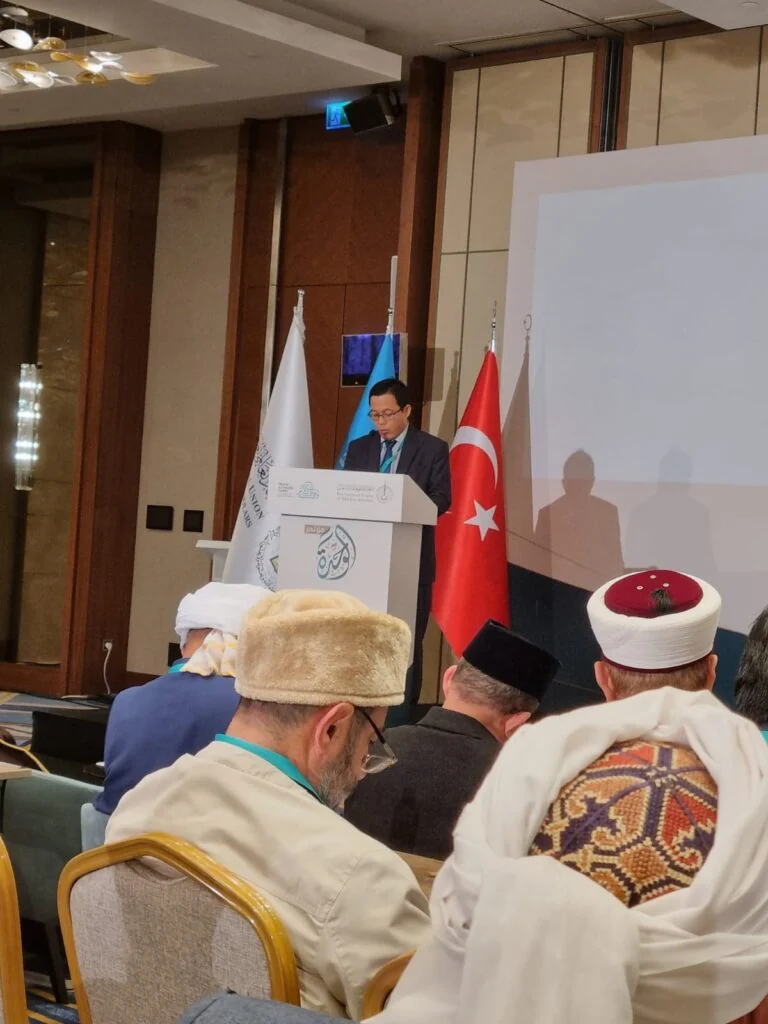
Participants at the Wahdat al-ummah al-Wasath International Conference of Muslim Scholars discussed the draft charter in Istanbul from October 28 to 30, 2026. Ali Muhyiddin al-Qaradaghi, Chairperson of the International UNion of Muslim Scholars, prepared the initial draft.
Before the conference, Muhammadiyah Central Board’s representative, Rofiq Muzakkir, submitted written comments on the draft to the conference’s Scientific Committee. During the charter deliberations on Wednesday (28/10), he presented four recommendations on behalf of Muhammadiyah.
Muhammadiyah’s Four Recommendations
First, the charter should affirm that progress in science, healthcare, and the economy is a religious imperative and part of the hayatan thayyibah (good and wholesome life) promised by Allah. Rofiq called for healthcare to be explicitly mentioned as a direct application of the principle of hifzh al-nafs (preservation of life).
Second, unity should be built on shared goals and collective action while respecting differences in scholarly interpretation. Choosing an opinion supported by stronger evidence, he emphasized, should not mean considering those who hold different views to be outside the Muslim community.
Third, the charter should include an implementation plan, with each provision assigned to a responsible institution and accompanied by annual targets.
Fourth, the Unified Global Hijri Calendar (Kalender Hijriah Global Tunggal) could serve as an example of collective action among Muslims.
Next Steps Regarding the Charter Drafting
“A unity charter will only be meaningful if it has a clear action plan. We should plan who will implement it and how its success will be measured each year. Muhammadiyah’s experience of more than a century shows that unity grows through collective work,” Rofiq said.
The conference committee subsequently appointed Rofiq as a member of the charter’s drafting team, alongside scholars from various countries.
At a meeting on Thursday, October 29, the drafting team agreed on the charter’s main principles. They are focusing in particular the importance of Muslim unity and al-‘amal al-musytarak (collective action) across various fields. The team will finalize the charter’s text online over the next month.
In addition to the charter, the conference produced al-Bayan al-Khitami (Closing Statement). The Assistant Secretary-General of the International Union of Muslim Scholars read the statement on Thursday (29/10). It was read again at the Hagia Sophia Mosque (Ayasofya) on Friday (30/10).
“Muhammadiyah will continue to oversee the drafting of this charter. We hope it will become a shared reference that inspires concrete action among Muslims,” Rofiq said.