

MUHAMMADIYAH.OR.ID, JEDDAH — During an international forum organized by the Organization of Islamic Cooperation (OIC) in collaboration with the Gulf Research Center through its Dialogue Lab program, Muhammadiyah presented a key development in efforts to unify the Islamic lunar calendar across the Muslim world.

The online forum, held on Sunday (8/3), discussed al-Turāts al-Tsaqāfī al-Syaʿbī fī Ramaḍān (Popular Cultural Heritage in Ramadan). Scholars and public figures from several countries attended the discussion.
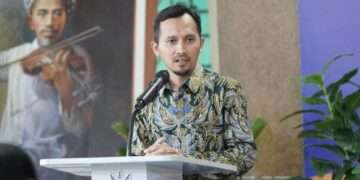
During the forum, Muhammad Rofiq Muzakkir, Secretary of the Muhammadiyah Central Board, announced that the organization had formally adopted the Unified Global Hijri Calendar (Kalender Hijriah Global Tunggal/KHGT). The system began implementation in Ramadan 1447 of the Islamic calendar.
“Allow me to convey an important development from Indonesia,” Rofuq said in Arabic. “Muhammadiyah, one of the largest Islamic organizations in the world, has officially adopted and begun implementing the Unified Global Hijri Calendar since Ramadan 1447 Hijri.”
A Calendar Based on Astronomical Calculation
Rofiq explained that the KHGT system views the entire Earth as a single lunar observation zone (maṭlaʿ wāḥid), or a unified horizon determining the start of the lunar month.
Therefore, the system follows the principle of “one day, one date for the entire world.” The calendar relies on precise astronomical calculation (al-ḥisāb al-falakī al-daqqīq), rather than depending solely on visual moon sighting (al-ruʾyah al-baṣariyyah).
According to Rofiq, this scientific approach allows Muslims to prepare worship schedules far in advance with greater certainty. Moreover, the system aims to reduce the recurring differences in determining the start of key Islamic months, including Ramadan, Shawwal, and Dhulhijjah.
These differences often occur even when astronomical data shows that the crescent moon already meets the necessary visibility criteria in many parts of the world.
Rofiq described the development of a global Hijri calendar as part of a broader civilization responsibility for the Muslim world. For more than fourteen centuries of Islamic history, Muslims have yet to implement a single Hijri calendar system used worldwide.
Because of this, Muhammadiyah hopes the OIC will play a more active role in facilitating dialogue among countries and Islamic schools of thought on the importance of a unified calendar system.
“We hope the Organization of Islamic Cooperation can play a more active role in facilitating dialogue among nations and different schools of thought to discuss the importance of this global calendar system,” Rofiq said.
However, Muhammadiyah emphasized that the initiative does not aim to impose one calculation method on every country or school of thought. Instead, the goal is to build a shared scientific and religious understanding that Muslims deserve a coordinated global calendar.
OIC Expresses Support for the Initiative
Muhammadiyah’s initiative aligns with broader discussions taking place across the Muslim world, including within the OIC itself.
During the official launch of the Unified Global Hijri Calendar in Yogyakarta on June 25, 2025 (29 Dhulhijjah, 1446), Tarig Ali Bakheet, Assistant Secretary General of the OIC for Humanitarian, Cultural, and Social Affairs, expressed strong appreciation for the initiative.
Ambassador Bakheet said the proposal resonates closely with the strategic objectives of the OIC as well as recent resolutions adopted by the organization.
One of the key international frameworks supporting the initiative is Resolution No. 1/51-C on the Unified Global Hijri Calendar. The resolution was adopted during the 51st Session of the OIC Council of Foreign Ministers in Istanbul in 2025.
The resolution explicitly encourages member states to adopt a unified Hijri calendar based on precise astronomical calculations. Such a system, according to the document, could strengthen religious coherence while also improving cooperation among OIC member states.
“Today, from the city of Yogyakarta, we are witnessing a historic step forward,” Ambassador Bakheet said in his speech. “The OIC is committed to working closely with Muhammadiyah and other stakeholders — in accordance with OIC resolutions — to promote and expand the adoption of this unified calendar model across the Muslim world.”
Nevertheless, he acknowledged that achieving a unified Islamic calendar would not be simple. The process requires patience, long-term vision and the willingness to bridge differences through dialogue, scientific understanding and sincerity.
Even so, official support from the OIC signals that Muhammadiyah’s effort to address what Rofiq described as a “civilizational debt” has begun to enter the mainstream agenda of global Muslim unity.
Translator: Bintang Adrian