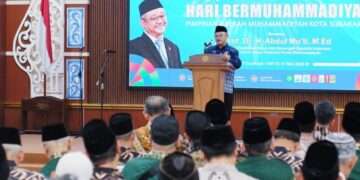


MUHAMMADIYAH.OR.ID, JAKARTA – Abdul Mu’ti, Secretary General of Muhammadiyah and Indonesia’s Minister of Primary and Secondary Education, said the Isra and Mi’raj marked a decisive spiritual turning point in the Prophet’s Muhammad’s struggle.

Speaking on Monday at Baitut Tholibin Mosque at the Ministry of Education complex in Central Jakarta, Mu’ti said the journey took place during one of the most difficult periods of the Prophet’s life. At the time, the prophet faced deep sorrow, isolation, and the mounting pressure against his mission.
According to Mu’ti, Isra and Mi’raj occured around the eleventh year of prophethood. One year earlier, the prophet lost two of his closest supporters. First, Abu Talib, his uncle, who had long protected him from persecution. Many historical accounts describe Abu Talib’s role as vital in safeguarding the early Islamic mission.
At nearly the same time, the Prophet also lost his wife, Khadijah. She stood beside him in hardship and ease alike. Moreover, she devoted her wealth to support the cause of Islam. Together, these losses defined what later became known as Amul Huzn, or The Year of Sorrow.
From Spiritual Trial to Collective Strength
Within that historical context, Mu’ti said, Isra and Mi’raj should be understood as a moment of spiritual reinforcement. Through this experience, the Prophet regained inner strength and clarity of purpose.
Soon afterward, the Prophet received the command to migrate from Mecca to Yathrib, later known as Medina. The migration, Mu’ti noted, was far from easy. Nevertheless, the Prophet moved forward despite threats to his life, because the mission had to continue.
At the heart of Isra and Mi’raj lies the command to perform prayer. Mu’ti emphasized that the Qur’an repeatedly links prayer with patience and divine help. Believers are urged to seek assistance through patience and prayer, because God stands with those who endure.
At the same time, prayer connects closely with charity. The Qur’an describes the righteous as those who pray consistently and share their sustenance with others. Therefore, Mu’ti argued, personal piety must lead to social responsibility.
Finally, he stressed that prayer also relates to victory. The Qur’an affirms that those who remain devoted and focused in their prayers are the ones who ultimately succeed.
Translator: Bintang Adrian