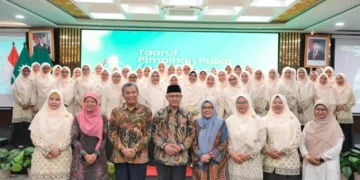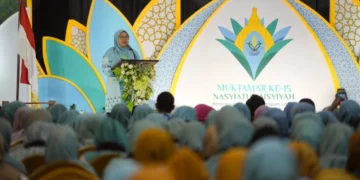


MUHAMMADIYAH.OR.ID, YOGYAKARTA – Lifelong learning stands as a defining trait of progressive young Muslim women, according to Ariati Dina, the President of Nasyiatul Aisyiyah Central Board (PPNA). She delivered the message during the opening of the Nasyiatul Aisyiyah Instructor Training, known as LINA, on Friday (02/01).

Speaking to participants, Ariati framed learning not as an optional pursuit but as a continuous responsibility. In her view, young women who seek to lead and nurture others must first commit to their own intellectual and personal growth. Therefore, she urged instructors and cadres alike to embrace learning as a lifelong process.
LINA, she explained, has become a crucial stage in Nasyiatul Aisyiyah’s cadre development system. The training demands loyalty, discipline and deep awareness of the organization’s instructional ideology. As a result, instructors cannot rely solely on experience or position.
“How can we give our best,” Ariati asked, “if we, as instructors, do not make time to keep learning ourselves?” Her question underscored a broader concern. Leadership, she argued, begins with humility and self-reflection.
Moreover, Ariati emphasized that LINA extends beyond technical instruction. Instead, it functions as a space for holistic growth. Emotional maturity, she said, remains just as important as ideological understanding. Consequently, the cadre process becomes a forum to manage ego, regulate emotions and refine personal intentions.
“This is a space to purify intention and realign the direction of instruction,” she said. Through that process, participants learn to balance authority with empathy and conviction with openness.
For Ariati, curiosity and a strong desire to learn define both cadres and instructors. She likened an ideal instructor to an empty glass, always ready to be filled with knowledge. In that sense, learning shapes not only skills but also character. Still, she acknowledged that the process requires patience and perseverance.
Looking ahead, Ariati expressed hope that the three-day training would encourage active participation and critical engagement. Meanwhile, the Central Board of Nasyiatul Aisyiyah aims to produce a new generation of competitive instructors. Ultimately, the organization seeks to nurture young female leaders who are ideologically grounded, emotionally mature and ethically committed to advancing Muhammadiyah’s mission. (Fiya) (Translated by Bintang Adrian)