
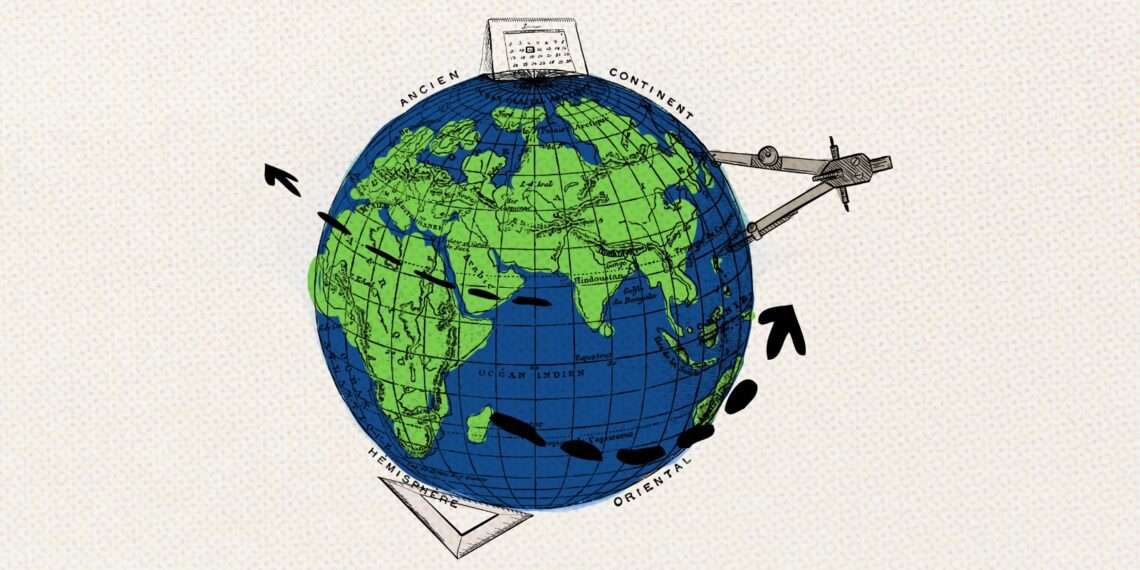
MUHAMMADIYAH.OR.ID, MEDAN – A member of the Council for Religious Opinion and Reform of Muhammadiyah Central Board (PP Muhammadiyah), Arwin Rakhmadi Juli Butarbutar, explained that in developing the Unified Global Hijri Calendar (Kalender Hijriah Global Tunggal/KHGT), criteria serve as the fundamental requirement.

Arwin conveyed this in his article titled “Criteria, Authority, and Scope of Applicability in the Global Islamic Calendar”, published on the official website of the Observatorium Ilmu Falak at Muhammadiyah University of North Sumatra (UMSU) on Wednesday (22/10).
According to Arwin, a popular view has long circulated that every form of Islamic calendar, whether local, regional, zonal, or global, must meet three requirements: criteria, authority, and territorial applicability. However, he argued, this perspective is not entirely accurate in the context of KHGT.
Arwin emphasized that criteria are the core element of any Islamic calendar system, as they determine the start of each new lunar month. Without clear criteria, a calendar cannot be systematically established.
He further explained that, at the global level, the criteria must be based on astronomical calculation (hisab) rather than direct observation (rukyat), since a calendar must be prepared far in advance to provide time certainty.
“A global calendar that still requires rukyat will never yield a definitive system,” Arwin wrote.
As example, he mentioned that Turkey’s decision in 1398 H/1978 AD and 1437 H/2016 AD adopted a criterion of a 5° moon altitude and 8° elongation, while the Jakarta Recommendation of 1438 H / 2017 CE used 3° altitude and 6.4° elongation. Each criterion, he noted, has its own strengths and weaknesses.
For Arwin, theological debates on hisab and rukyat remain important, yet the modern Muslim world needs a unifying and globally applicable calendar.
He argued that authority is not an essential requirement for forming a global islamic calendar, since no scriptural basis mandates the presence of a specific authority to establish it.
“If such an authority exists and is respected, it is certainly beneficial, but it is not a necessity without which the global calendar becomes invalid,” he stated.
Instead, Arwin stressed the importance of building a robust, evidence-based, and scientific concept, and then communicating it effectively to the international community. He also pointed out potential issues if “authority” were to be made a precondition, such as who would qualify as the global Islamic authority, how it would function, and what would happen if its legitimacy were questioned.
Regarding territorial applicability, Arwin clarified that a global unified calendar does not require defined territorial boundaries, since its very nature is comprehensive and universal.
Making territorial scope a requirement, he argued, would contradict the principle of globality inherent in such a calendar.
However, he distinguished this from zonal calendars such as those used by MABIMS or Mohammad Ilyas, which necessarily include territorial limits due to their regional focus.
In conclusion, Arwin stated that among the three commonly cited prerequisites—criteria, authority, and scope of applicability—only criteria remain relevant for a global unified Islamic calendar. Meanwhile, authority and territorial applicability are not mandatory. For regional or zonal calendars, territorial boundaries are conceptually necessary but automatically implied due to geographical constraints.
“What matters most in all types of Islamic calendars is their compatibility and validity both scientifically and religiously, so that they may be accepted universally,” Arwin concluded. (Bintang Adrian)