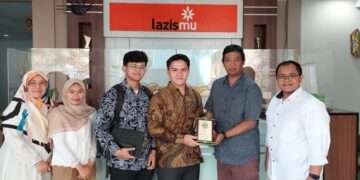


EN.MUHAMMADIYAH.OR.ID, JAKARTA – Muhammadiyah Department of Charity Management, Lazismu, received a delegation from the King Hussein Cancer Foundation and Center (KHCC) of Jordan on Tuesday (4/8) at the Muhammadiyah Central Board Office in Jakarta.

The meeting marked an initial step toward humanitarian cooperation to support care for Palestinian cancer patients currently receiving treatment in Jordan.
Ahmad Imam Mujadid Rais, Chairperson of Lazismu, received the delegation. Representatives from the Muhammadiyah Disaster Management Center (MDMC) and Muhammadiyah AID also attended the meeting.
The two sides discussed potential collaboration to assist cancer patients from Gaza who must seek treatment in Jordan after the destruction of health facilities in the territory.
Rais said KHCC focuses on cancer care, including for Palestinians referred to Jordan because hospitals in Gaza can no longer provide adequate medical services.
“Today, we welcomed two delegates from King Hussein Cancer Foundation and Center in Amman, Yordania. They came to strengthen ties and explore possible collaboration with Muhammadiyah, especially Lazismu, in supporting medical treatment for Palestinian cancer patients,” Rais said.
According to Rais, before the Middle-East conflict escalated further, health care needs among Palestinian refugees were already severe. The situation has since become more difficult following the escalation involving Iran, Israel, and the United States. As a result, international support for the foundation has declined.
“They told us that donations have continued to decrease. Therefore, they hope to establish cooperation with Lazismu so that the needs of these patients can continue to be met,” Rais added.
Gaza Patients Face Growing Medical Needs
During the meeting, the KHCC delegation said around 492 Palestinian cancer patients are currently receiving treatment at the hospital. The number could rise to approximately 520 patients by 2027. Most of them are palestinian refugees from Gaza. Many arrive with family members who accompany them during treatment.
However, Rais said the patients face challenges even before reaching the hospital. They must undergo strict security screening. As a result, some children eventually receive treatment without either of their parents.
“There are children with cancer whose fathers or mothers are not allowed to enter and accompany them. In the end, neighbors or even strangers have to stay with them throughout their treatment. This is deeply concerning and requires our collective attention,” he said.
The needs identified by KHCC extend beyond medical expenses. They include transportation, accommodation for patients and their families, and medical equipment. Lazismu will assess their needs before determining the most appropriate form of cooperation.
“We will communicate further after this meeting. We will identify the most urgent needs, whether transportation, accommodation, treatment, or medical equipment. After that, we will invite Lazismu branches across Indonesia to jointly raise funds. The assistance will be centralized through Lazismu before being delivered to the KHCC,” Rais explained.
Jordan Offers a Practical Humanitarian Channel
Delivering assistance through Jordan offers a realistic option because direct access to Gaza remains extremely difficult amid deteriorating security conditions.
“We discussed how severe the situation in Gaza is today, making direct assistance almost impossible. Therefore, supporting hospitals that treat the survivors is one solution that we can pursue,” Rais said.
Lazismu has previously delivered humanitarian assistance to Jordan on several occasions. During two earlier missions, it distributed food, medicine, clothing and other basic necessities to Palestinian refugees living in several camps across the country.
Rais said Lazismu had actually learned about KHCC during a visit to Jordan last year. At the time, however, the organization had not yet found an appropriate channel for communication.
“Last year, when we visited Jordan, we had already heard about this institution. However, we did not yet have the right communication channel. Alhamdulillah, today’s meeting has opened an opportunity for more specific cooperation, particularly to support Palestinian cancer patients,” he said.
Rais hopes the prospective partnership will strengthen Muhammadiyah’s humanitarian work at the global level. It would also expand the organization’s contribution to communities affected by conflict.
“We hope this cooperation can become part of global humanitarian solidarity as well as Muhammadiyah’s internationalization process. May this collaboration run well and effectively, and truly benefit Palestinian survivors, particularly those fighting cancer,” Rais concluded. (Taufik)