

EN.MUHAMMADIYAH.OR.ID, YOGYAKARTA – Muhammadiyah as a non governmental organization (NGO) prioritizes humanitarian-based peace building instead of direct political mediation in conflict areas across Southeast Asia, according to the organization’s chairman, Haedar Nashir.

Haedar made the remarks on Tuesday (12/5) during a postgraduate open session at Muhammadiyah University of Yogyakarta.
As a sociology professor, Haedar explained that NGOs such as Muhammadiyah have limitations in resolving armed conflicts directly. In his view, the responsibility for formal peace negotiations belongs primarily to governmental and international institutions with legal authority.
“If an NGO crosses into direct peace making, it becomes difficult,” Haedar said. “That role belongs to states and institutions that possess official authority.”
Instead, Muhammadiyah focuses on peace building, which includes humanitarian assistance, social recovery, and strengthening solidarity among affected communities.
According to Haedar, the organization has applied that approach in humanitarian crises involving Rohingya people.
Collaboration with Governments Remains Essential
Although Muhammadiyah and state authorities hold different roles, Haedar stressed that cooperation between civil society organizations and governments remains important.
Through its humanitarian work, Muhammadiyah has witnessed how difficult conflict resolution can become, even within the ASEAN region.
“Even states often struggle to stop conflicts on that scale,” he said.
Haedar pointed to ongoing global tensions involving countries such as the United States, Israel, and Iran as examples of disputes that remain beyond the reach of many organizations.
According to him, institutions like the United Nations should carry the main responsibility for preventing wars and large-scale violence.
Therefore, he argued, it would be unrealistic to expect religious organizations alone to stop armed conflicts.
“Usually, what organizations like Muhammadiyah can offer is a moral voice,” he explained.
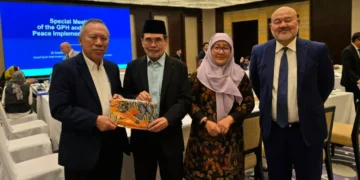
Despite the limitations, Haedar emphasized that Muhammadiyah does not remain passive during humanitarian crises. He cited the organization’s involvement in conflict-related efforts in the Philippines as an example of how Muhammaidyah attempted to contribute more actively to peace initiatives.
“In the Philippines, there were opportunities for us to contribute to peace making,” Haedar said. “But, we still had to work through the state and through diplomatic relations between Indonesia and the Philippines.