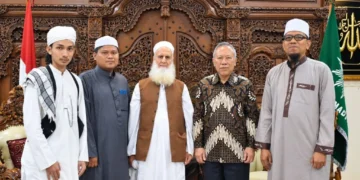


MUHAMMADIYAH.OR.ID, YOGYAKARTA – The debate of the use of lard in the manufacturing process of food trays used in Free Nutritious Meal Program (MBG) has forced the National Nutrition Agency to seek for religious judgement from the Council of Religious Opinion and Tajdid of the Main Board (PP) of Muhammadiyah.

The Chairman of the National Nutrition Agency, Dadan Hidayana, explained that since the beginning of the MBG program, most of the food trays have been imported as they are considered to have a better quality.
Lately, domestic production has begun to grow by involving 38 local manufacturing industries, which have produced over 11 millions units of food tray. The number, however, is still insufficient to meet the demand, therefore imports will still be necessary.
Dadan conveyed, the use of some sort of oil is needed in the process of food tray production. It serves as a lubricant for the machine while performing the stamping process, the process of turning metal plates into the final product. He also asserted that the main material of the tray is a combination of chromium and nickel, so any kind of oil will not stick to the final product.
Even so, he makes sure every imported product for MBG must have a halal certificate. The National Nutrition Agency, said Dadan, has given the chance for religious institutions, including Muhammadiyah, to observe both the factory and the production process.
“Every institution importing their products to Indonesia must get through halal certification. Muhammadiyah could do an inspection. As far as I know, pork is haram to be eaten and najis to be touched, but what if it is already sterilized? Kindly examine it from the perspective of fiqh (Islamic jurisprudence),” Dadan said.
Furthermore, Dadan emphasized that food safety remains their top priority. According to him, the food poisoning cases were unrelated to the trays, but rather caused by the poor-quality ingredients, unhygienic cooking processes, and the use of substandard water.
From a religious standpoint, Wawan Gunawan Abdul Wahid, member of the Council for Religious Opinion and Tajdid PP Muhammadiyah, stated that plant-based food containers are basically safe to use. He also confirmed that domestic products are more reliable. “If it’s made in Indonesia, insyaAllah it’s halal. We are positive it’s halal,” he explained.
However, when it comes to imported goods, Wawan emphasizes that a deeper examination is needed to confirm their halal status. He reminded that in Indonesia, the Indonesian Ulama Council has strictly regulated that the use of lard or other pig-derived materials are forbidden, a similar stance also shared by some scholars in Nahdlatul Ulama.
In the perspective of fiqh, explained Wawan, the foundational principle that needs to be considered is the instruction to choose what is halalan thayyiban as a part of hifz al-din (preservation of religion). Therefore, the question arises as to how Muhammadiyah positions itself in response to this case.
The Council for Religious Opinion and Tajdid stated that this problem will be observed from a deeper fiqh and technical perspective to provide clarity and recommendation. (Bintang Adrian)