



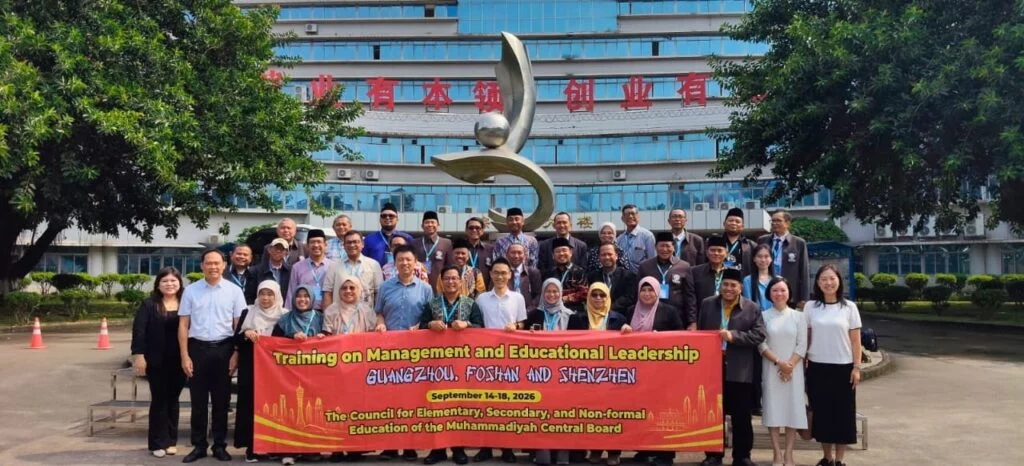
EN.MUHAMMADIYAH.OR.ID, CHINA – Muhammadiyah Council for Primary, Secondary, and Nonformal Education (Dikdasmen PNF) organized a Training on Management and School Leadership in Guangzhou, Foshan, and Shenzhen, China, from September 14–18, 2026.

The program brought together 32 participants, including members of the Dikdasmen PNF Council and school principals from various parts of Indonesia. It was organized in cooperation with the Council and the Embassy of the People’s Republic of China in Indonesia.
The program aims to strengthen participants’ capacity and broaden their understanding of school management, educational leadership, vocational education development, and emerging educational practices in China.
The initiative is part of Muhammadiyah’s efforts, through its Dikdasmen PNF Council, to strengthen educational exchanges and cooperation between Indonesia and China.
Didik Suhardi, Chairperson of the Muhammadiyah Central Board’s Dikdasmen PNF Council, said the agenda should serve as a strategic learning opportunity for all participants.
He also expressed hope that the good practices encountered during the program could be brought back to Indonesia and adapted to the Muhammadiyah education system. Their implementation, he said, should take into account the character, values, and needs of education within Muhammadiyah.
Take part in every activity seriously and make the most of it. What you learn should bring change and contribute to the advancement of Muhammadiyah education. Observe good practices, study them, and then modify them according to our needs,” Didik said Thursday (17/9).
Learning From China’s Education System
R. Alpha Amirrachman, Vice Chairperson of the Muhammadiyah Central Board’s Dikdasmen PNF Council, said international experiences such as this could contribute to the transformation of education within Muhammadiyah.
“This program is going to strengthen Muhammadiyah’s educational network so that it can become more advanced, excellent, adaptive, and globally competitive without losing the identity and values that form the foundation of its education,” he said.
Over the five-day program, participants took part in a series of educational activities and field visits across three cities.
In Guangzhou, they visited Guangzhou Xiehe Middle School and Guangzhou Huimin Primary School.
The delegation then traveled to Foshan, where participants visited Shunde Leung Kau Kui Vocational and Technical School. The visit provided them with a firsthand look at the delivery of secondary-level vocational education.
Finally, in Shenzhen, the participants visited Shixia School and the Shenkang Campus of Hongling Education Group.
The visits across three cities exposed participants to a range of educational levels and models. They were able to study, compare, and analyze different approaches to school leadership, institutional governance, human resource development, and learning environment. (Bhisma)


